Automatic Corrugated Roofing Sheet Machine (1330 mm G.C.): 14-Stand Roll Forming, Siemens PLC & Industrial Buying Guide (2026)
Published: November 14, 2026 | By Gagan Engineering Technical Editorial Desk
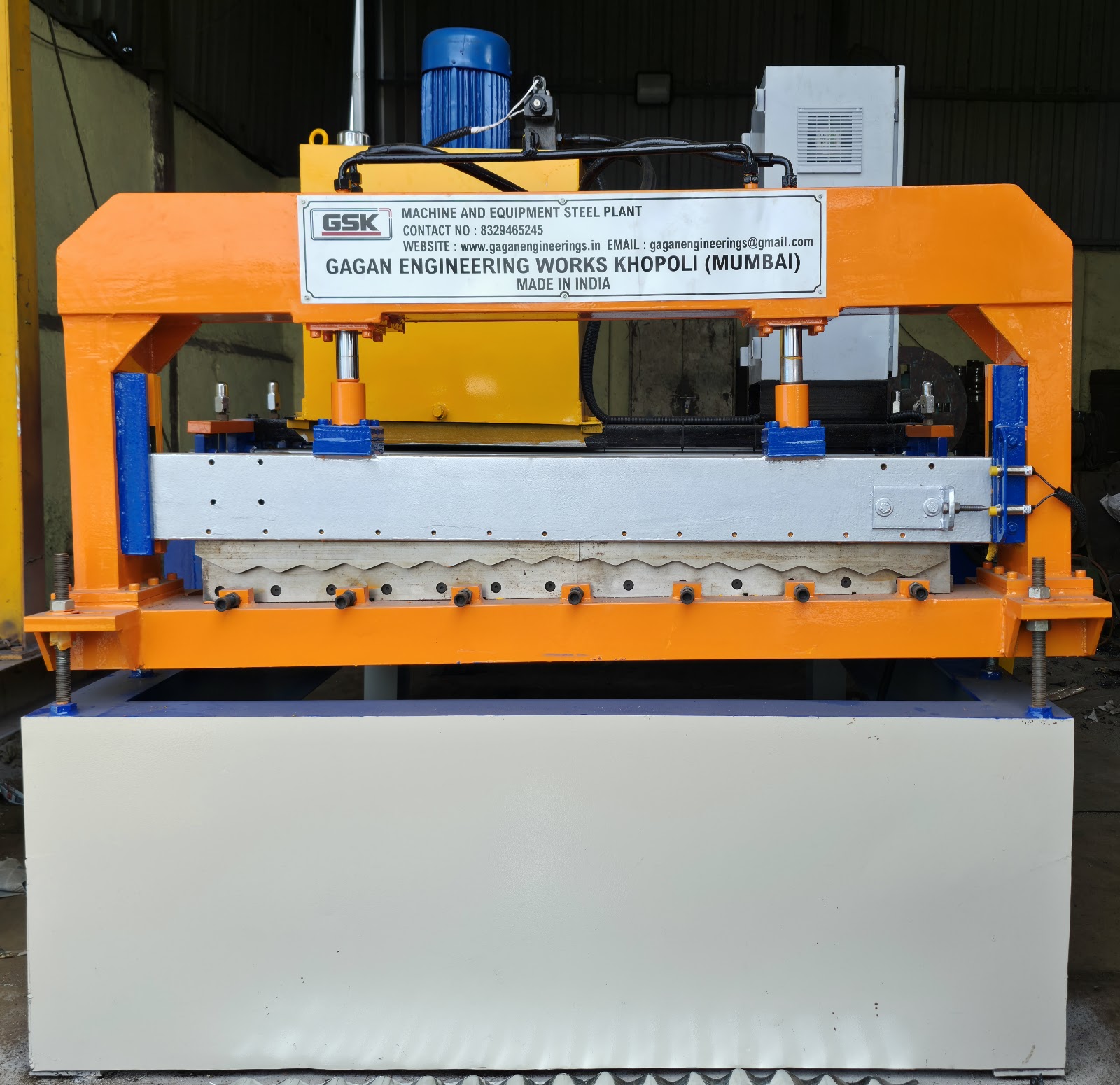
Comprehensive engineering guide to the 1330 mm G.C. Automatic Corrugated Roofing Sheet Machine manufactured by Gagan Engineering Works in Khopoli, Maharashtra. Featuring 14 progressive forming stations on 90 mm solid shafts, 168 mm hard chrome rollers, 10 HP motor, Siemens SIMATIC TP700 HMI, Fuji Frenic VFDs, Omron encoder, exit back cutter with manual lever shear, profile drawing (17 waves, 75 mm pitch), and plant ROI.
1. What is an Automatic Corrugated Roofing Sheet Machine (1330 mm G.C.)?
An Automatic Corrugated Roofing Sheet Machine (1330 mm G.C.) is a continuous heavy-duty cold roll forming production line specifically engineered to transform flat galvanized steel, Galvalume, and pre-painted metal coils into high-strength sinusoidal corrugated roofing and cladding panels. Designed and precision-built by Gagan Engineering Works in Khopoli, Maharashtra, this industrial production line features an overall machine footprint of 7 feet (W) × 35 feet (L) and operates at line speeds of 10 to 20 meters per minute with an automated cut-to-length tolerance of ±1.0 mm.
Unlike traditional manual or semi-automatic corrugation presses that stamp sheets stroke by stroke with high cycle times and non-uniform wave geometry, this 14-station continuous roll forming system processes master coils at the standard 1330 mm G.C. (Galvanized Corrugated) flat input strip width. As the steel strip passes through the 14 progressive forming stations, solid 90 mm diameter forged alloy shafts drive 168 mm outer diameter CNC-contoured forming rollers, gradually shaping 17 continuous sinusoidal waves without stretching the material, cracking protective zinc coatings, or inducing edge waviness.
The entire production line is governed by a centralized Siemens SIMATIC TP700 Touchscreen HMI and Siemens PLC automation console, paired with three Fuji Electric Frenic series VFDs and a high-resolution Omron optical rotary encoder. Sheet cutoff is executed by a heavy-duty exit-mounted back cutter manufactured from hardened Cr12MoV alloy tool steel, equipped with a manual slide lever for effortless test sample trimming and maintenance operations.
Whether you are an established roofing manufacturer upgrading to an automated line or an industrial entrepreneur entering the pre-engineered building (PEB) sector, this Automatic Corrugated Roofing Sheet Machine paired with our 10 Tons Hydraulic Decoiler provides a turnkey, high-output manufacturing solution backed by domestic Indian engineering and lifetime factory support.
- Flat Strip Feed Width: 1330 mm G.C. standard commercial coil strip.
- Formed Profile Dimensions: 17 sinusoidal waves at 75 mm pitch; 1279 mm (+20/-15 mm) overall formed width; 1200 mm (+20/-15 mm) effective cover width.
- Thickness Processing Window: 0.25 mm to 0.6 mm in Galvanized Iron (GI), PPGI, Pre-Painted Galvalume (PPGL), and Aluminium.
- Tooling & Stand Engineering: 14 progressive forming stations; 90 mm solid high-tensile shafts; 168 mm CNC-machined rollers with 0.05 mm hard chrome mirror plating.
- Main Drive Power: 10 HP (7.5 kW) heavy-duty electric motor with triple Fuji Electric Frenic VFD frequency regulation.
- Automation Architecture: Siemens PLC, Siemens SIMATIC TP700 7"/9" TFT color HMI, Omron rotary encoder, and Schneider Electric France low-voltage switchgear.
- Exit Back Cutter System: Hydraulic high-grade hardened alloy steel shearing blade contoured to sinusoidal profile with auxiliary manual slide lever.
2. Corrugated Sheet Profile Drawing: 1330 mm Feed, 17 Waves & 75 mm Pitch
The structural load-bearing capacity and weatherproofing performance of a corrugated roofing sheet depend directly on its wave geometry and dimensional uniformity. The Gagan Engineering Works 1330 mm G.C. line is engineered to produce the classic 17-wave sinusoidal profile from an input flat coil width of exactly 1330 mm, maximizing sheet coverage while maintaining optimum section modulus.
The engineering profile drawing below illustrates the precise dimensional relationships across the finished sheet:

- Flat Sheet Feed Width (Input): 1330 mm. This wide commercial feed width allows roofing fabricators to produce wider coverage panels from standard master coils compared to older 900 mm or 1000 mm narrow lines.
- Number of Sinusoidal Waves: Exactly 17 continuous repetitive sinusoidal waves (numbered 1 through 17 in the engineering schematic).
- Wave Pitch: 75 mm centre-to-centre between adjacent wave crests. This uniform 75 mm pitch distributes rainwater runoff evenly across the roofing surface and prevents localized ponding.
- Overall Formed Sheet Width: 1279 mm (+20 mm / -15 mm tolerance). This represents the total outer edge-to-edge dimension of the profiled sheet after transverse metal shrinkage across the 14 forming stations.
- Effective Cover / Laying Width: 1200 mm (+20 mm / -15 mm tolerance). When installed on purlins with standard 1.5 to 2 wave side laps, each sheet provides a net weather-sealed coverage of 1.20 meters.
- Installation Efficiency: The wide 1200 mm effective cover width reduces total panel count per roof by 20% to 28% compared to standard 900 mm sheets, saving contractors significant purlin fastening hardware, EPDM washers, and installation crane time.
3. 14-Station Progressive Roll Forming Physics: 90 mm Shafts & 168 mm Rolls
Roll forming a 1330 mm wide sheet into 17 distinct sinusoidal waves simultaneously requires careful management of transverse metal flow. Unlike narrow profiles, a 1330 mm strip undergoes significant transversal contraction as the flat metal is drawn into 17 sinusoidal valleys and crests (contracting from 1330 mm flat to 1279 mm formed width—a net transversal shrinkage of ~51 mm).
If this deformation is forced through too few stations (e.g., 8 to 10 stations), the excessive strain rate creates severe edge wave ('oil canning'), uneven wave depths, and zinc coating flaking on pre-painted or galvanized stock. Gagan Engineering Works engineers solve this by distributing the forming strain across 14 progressive forming stations:
1. Progressive Radial Infeed: In the initial 4 stations, the centre corrugations (waves 8, 9, 10) begin forming while the strip edges remain relaxed. Progressive outer waves (waves 5–7 and 11–13) engage in stations 5 through 9, and outer perimeter waves (waves 1–4 and 14–17) finish in stations 10 through 14. This progressive inward-to-outward metal drawing eliminates residual stresses and oil canning.
2. 90 mm Solid High-Tensile Shafts: Many low-cost fabricators use 65 mm or 75 mm hollow shafts made of mild steel EN8, which deflect under the continuous forming loads of 0.6 mm thick full-hard 550 MPa Galvalume coils. Gagan Engineering Works machines use solid 90 mm diameter forged steel shafts, CNC-turned and key-slotted for high torsional rigidity, ensuring zero shaft deflection across the full 1330 mm roll span.
3. 168 mm CNC-Contoured Rollers with Hard Chrome Mirror Finish: Forming rollers are CNC-lathe machined from high-grade EN31 / Cr12 alloy tool steel and vacuum-hardened. Each roller undergoes precision cylindrical grinding and 0.05 mm hard chrome electroplating with a mirror surface finish. This scratch-free surface protects the delicate primer and polyester paint finishes of colour-coated coils (PPGI and Galvalume), eliminating micro-cracking and zinc dust accumulation.
- Shaft Diameter: 90 mm solid forged alloy steel (heavy-duty keyed drive).
- Roller Outer Diameter: 168 mm precision CNC-contoured rolls.
- Roller Metallurgy: Vacuum-hardened EN31 / Cr12 high-carbon chromium alloy steel.
- Surface Treatment: 0.05 mm (50 micron) hard chrome electroplating with mirror polishing.
- Transmission: Heavy-duty industrial roller chains and sprockets powered by centralized helical bevel reduction gearbox.
- Forming Stand Frames: 30 mm thick solid steel vertical side plates mounted on heavy ISMB beam base frame (7 ft × 35 ft).
Technical Specifications Matrix: 14-Stand Automatic Corrugated Machine
| Engineering Parameter | Gagan Engineering Works Specification | Industrial Significance & Benefit |
|---|---|---|
| Machine Model & Name | Automatic Corrugated Roofing Sheet Machine | Continuous automated industrial roll forming line |
| Machine Dimensions (Footprint) | 7 Feet (Width) × 35 Feet (Length) × 4 Feet (Height) | Robust structural layout with optimal station spacing |
| Input Coil / Sheet Width | 1330 mm G.C. (Galvanized Corrugated) Flat Strip | Standard commercial coil width maximizing net roof coverage |
| Sheet Thickness Processing Range | 0.25 mm to 0.60 mm | Covers economy rural sheets up to heavy industrial shed panels |
| Number of Forming Stands | 14 Progressive Forming Stations | Uniform deformation prevents paint cracking and oil-canning waviness |
| Shaft Diameter | 90 mm Solid High-Tensile Forged Steel Shafts | Zero shaft deflection under continuous full-hard 550 MPa forming loads |
| Roller Outer Diameter & Material | 168 mm CNC-Contoured EN31/Cr12 Alloy Steel | Vacuum-hardened to 58–62 HRC with 0.05 mm hard chrome mirror plating |
| Finished Wave Geometry | 17 Sinusoidal Waves @ 75 mm Pitch | 1279 mm (+20/-15 mm) overall width; 1200 mm (+20/-15 mm) cover width |
| Main Drive Electric Motor | 10 HP (7.5 kW) Heavy-Duty High-Torque AC Motor | Provides reliable mechanical torque through reduction gearbox |
| Variable Frequency Drive (VFD) | 3× Fuji Electric Frenic Ace / Mini VFDs (0.4–7.5 kW) | Smooth speed ramping, synchronized drive, and dynamic braking |
| Line Forming Speed | 10 to 20 Meters per Minute (Adjustable) | High daily throughput delivering up to 6,000 meters per 8-hour shift |
| PLC Automation Controller | Siemens PLC with Digital I/O | Centralized real-time execution of feeding, forming, and shearing |
| Operator Interface (HMI) | Siemens SIMATIC TP700 7"/9" TFT Color Touchscreen | English interface, batch recipe storage, diagnostic alarms, USB/PROFINET |
| Length & Quantity Measurement | Omron High-Resolution Optical Rotary Encoder | Guarantees length accuracy within ±1.0 mm tolerance |
| Exit Back Cutter System | Hydraulic Post-Cut Shear + Auxiliary Manual Slide Lever | High-grade hardened alloy blade contours wave shape; manual lever for test cuts |
| Low-Voltage Switchgear | Schneider Electric (France) MCBs & Contactors | Industrial-grade overload, short-circuit, and thermal protection |
| Control Panel Enclosure | CRCA Sheet Metal, Powder-Coated (Siemens Grey) | Dust-proof, IP54 rated industrial electrical enclosure |
| Power Supply Requirement | 380V / 440V, 3-Phase, 50 Hz / 60 Hz | Compatible with domestic Indian industrial grids and export standards |
| Manufacturer & Warranty | Gagan Engineering Works (Khopoli, Maharashtra) — 1 Year | Comprehensive factory warranty with on-site commissioning & spare parts |
5. Siemens PLC Automation Panel, Fuji Electric VFDs & Omron Optical Encoder
At the core of the Gagan Engineering Works Automatic Corrugated Roofing Sheet Machine is an international-grade electrical automation console. Where many competitors use unbranded relay logic or low-cost cloned controllers that suffer from memory drift and frequent electrical breakdowns, this line incorporates a premium control architecture engineered for high speed, long service life, and continuous industrial precision.
The operator console is housed in a heavy-duty CRCA sheet metal enclosure powder-coated in Siemens grey, providing IP54 dust and oil protection. The system runs on 380V / 440V 3-phase power (50 Hz / 60 Hz) with an internal 24V DC SMPS power supply for all sensitive electronics and sensor circuits.
The specification sheet below outlines the complete electrical panel component breakdown:
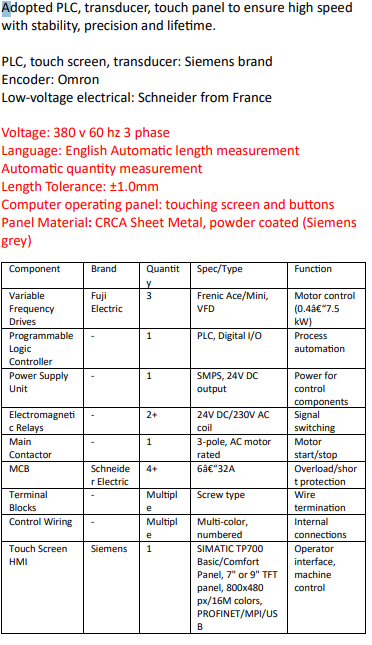
- Siemens SIMATIC TP700 Touchscreen HMI: High-resolution 7" or 9" TFT widescreen display (800×480 pixels, 16 million colors) with PROFINET, MPI, and USB interfaces. The English-language interface allows the operator to enter target sheet lengths, batch quantities, acceleration ramps, and cutter timing in seconds.
- Siemens Programmable Logic Controller (PLC): High-speed industrial PLC with digital I/O orchestrating the closed-loop synchronization between coil feeding, VFD acceleration, encoder pulse counting, and hydraulic shearing action.
- Triple Fuji Electric Frenic VFDs: Three separate Fuji Electric Frenic Ace / Mini variable frequency drives (ranging from 0.4 kW to 7.5 kW) control motor acceleration, line speed ramping, and deceleration, ensuring jerk-free stops before each cutting cycle.
- Omron High-Precision Optical Rotary Encoder: Direct-coupled wheel encoder riding on the sheet surface provides continuous real-time length tracking, ensuring a precise cutting tolerance of ±1.0 mm regardless of line speed fluctuations.
- Schneider Electric (France) Low-Voltage Switchgear: Equipped with Schneider 6A to 32A MCBs (4+ units), electromagnetic relays (24V DC / 230V AC coils, 2+ units), and heavy-duty 3-pole AC motor main contactors for maximum electrical safety.
- Dual Operating Modes: The control console provides both automated touch-screen operation and physical manual override push-buttons, an illuminated master emergency stop (E-stop), and numbered ferrule control wiring for rapid diagnostic tracing.
Control Console & Electrical BOM (Bill of Materials)
| Component | Brand / Manufacturer | Quantity | Specification / Type | Engineering Function |
|---|---|---|---|---|
| Variable Frequency Drives (VFDs) | Fuji Electric | 3 Units | Frenic Ace / Mini VFD (0.4 kW – 7.5 kW) | Smooth motor speed regulation, soft starting, and dynamic braking |
| Programmable Logic Controller (PLC) | Siemens | 1 Unit | Siemens Industrial PLC with Digital I/O | Centralized real-time process automation and encoder tracking |
| Power Supply Unit (SMPS) | Industrial Certified | 1 Unit | SMPS, 24V DC Output (Regulated) | Stable low-noise DC power for PLC, sensors, relays, and HMI |
| Electromagnetic Relays | Industrial Grade | 2+ Units | 24V DC / 230V AC Coil | Galvanic isolation and auxiliary signal switching |
| Main AC Contactor | Schneider Electric | 1 Unit | 3-Pole, AC Motor-Rated Heavy Contactor | Main motor power switching and safe overload isolation |
| Miniature Circuit Breakers (MCB) | Schneider Electric (France) | 4+ Units | 6A to 32A DIN-Rail Mounted MCBs | Branch circuit overload and short-circuit protection |
| Terminal Blocks | Heavy-Duty | Multiple | DIN-Rail Screw Type Terminals | Secure, vibration-proof field wire terminations |
| Control & Signal Wiring | Multi-Core Flexible | Multiple | Multi-color, numbered ferrule identification | Clean, organised cabinet layout for fast troubleshooting |
| Touchscreen Operator HMI | Siemens | 1 Unit | SIMATIC TP700 Basic/Comfort, 7" or 9" TFT, 800×480 px, PROFINET/MPI/USB | Primary operator interface, batch counting, and fault diagnostics |
| Length Rotary Encoder | Omron | 1 Unit | Optical Incremental Rotary Encoder | High-resolution real-time sheet length feedback (±1.0 mm) |
7. Exit-Mounted Heavy-Duty Back Cutter & Manual Lever Shearing Mechanism
The cutting station on a corrugated roll forming line is subjected to severe cyclic shear forces. If the shearing blades are flat or improperly aligned, the cut edge will crush the corrugated wave profile, creating burred ends that fail to interlock during roofing installation. The Gagan Engineering Works Automatic Corrugated Machine incorporates an engineered exit-mounted back cutter designed for continuous heavy-duty service.
Key engineering features of the back cutter system include:
1. Continuous Cutting Operation: Provides a strong, stable, and smooth cutting action engineered for non-stop automated manufacturing. Powered by a dedicated 4.0 kW hydraulic power pack with proportional flow control valves, the upper blade shears cleanly through the profiled sheet in under 1.2 seconds without stopping production momentum.
2. Mounted Directly at Machine Exit: Positioning the back cutter directly at the exit of station 14 guarantees the perfect shape accuracy of the corrugated profile. Because the sheet is supported by the final forming rolls as it enters the cutting dies, the panel cannot twist, bow, or deflect during the shearing stroke.
3. High-Grade Hardened Alloy Steel Blades: Both upper and lower cutting dies are CNC wire-cut to match the exact 17-wave sinusoidal contour. Manufactured from premium Cr12MoV vacuum heat-treated alloy tool steel (hardened to 60–62 HRC), the blades offer exceptional wear resistance, retaining razor-sharp cutting edges through hundreds of thousands of cuts without burring or chipping.
4. Auxiliary Manual Slide Lever Mechanism: In addition to automated PLC-triggered hydraulic cutting, the back cutter features a precision manual slide lever. By simply sliding the lever, the operator can manually cut the sheet at any moment. This capability is invaluable during initial coil threading, test sample extraction for thickness/profile verification, coil end splicing, or emergency cut-offs without needing to cycle through the automated touchscreen program.
- Cutting Action: High-speed, smooth hydraulic post-forming guillotine shear.
- Location: Mounted directly at the roll forming exit for flawless shape retention.
- Blade Material: Premium vacuum heat-treated Cr12MoV alloy tool steel (60–62 HRC).
- Contoured Profile: Exact 17-wave sinusoidal profile mating dies ensuring 100% burr-free cuts.
- Manual Override: Built-in manual slide lever for effortless manual cutoff and sample testing.
- Hydraulic Drive: 4 kW dedicated hydraulic power station with oil cooler and pressure regulator.
8. Raw Material Compatibility: GI, PPGI, PPGL & Galvalume Coils
The 14-station tooling of the Gagan Engineering Works Corrugated Sheet Machine is engineered to process the full spectrum of industrial steel and alloy coils currently used in construction across India and global export markets:
1. Galvanized Iron (GI) Coils: Conforming to IS 277 / ASTM A653, with zinc coating weights ranging from Z90 to Z275 g/m². The hard-chromed rolls prevent zinc powder peeling and flaking even at maximum production speeds.
2. Pre-Painted Galvanized Iron (PPGI): Siliconized Modified Polyester (SMP), Regular Modified Polyester (RMP), or PVDF coatings applied over galvanized base steel. The 0.05 mm mirror-finish chrome rolls ensure scratch-free forming without damaging topcoats or backer coats.
3. Pre-Painted Galvalume (PPGL / Al-Zn Alloy): High-tensile steel coated with 55% Aluminium, 43.4% Zinc, and 1.6% Silicon (conforming to ASTM A792 / AS 1397). The machine effortlessly forms high-yield 550 MPa (full-hard G550) coils in thicknesses from 0.30 mm to 0.50 mm without cracking.
4. Aluminium Alloys: AA3003 and AA3105 architectural aluminium coils in 0.40 mm to 0.60 mm thicknesses, producing lightweight, corrosion-proof roofing panels for coastal and chemical environments.
To achieve uninterrupted, high-volume production, roofing manufacturers typically feed this line using our 10 Tons Hydraulic Decoiler, which provides hydraulic mandrel expansion, motorized uncoiling, and a heavy-duty pneumatic snubbing arm to prevent coil clock-springing.
- Thickness Window: 0.25 mm to 0.60 mm (calibrated for standard 0.30 mm, 0.35 mm, 0.40 mm, 0.45 mm, and 0.50 mm commercial thicknesses).
- Tensile Strength Handling: From soft commercial quality steel (CQ 250–300 MPa) up to full-hard Galvalume (G550 MPa).
- Surface Finish Integrity: Zero paint micro-cracking, zero zinc spangle abrasion, and zero roll mark transfers.
- Decoiler Integration: Fully compatible with manual 5-ton decoilers and heavy-duty 10-ton hydraulic uncoilers with loop control.
9. Daily Production Capacity, Plant Economics & Commercial ROI (2026)
Investing in an automated 14-stand corrugated roll forming line represents a high-return capital investment for roofing sheet manufacturers and metal service centres. The economics of modern continuous roll forming offer substantial advantages over manual press operations:
### Daily Output & Throughput Metrics (8-Hour Shift)
- Operating Speed: 15 meters per minute nominal speed (adjustable from 10 to 20 m/min).
- Effective Running Efficiency: 70% net utilization factor (accounting for coil changes, batch programming, and bundle strapping).
- Linear Meters Produced: In an 8-hour shift, net production reaches 5,040 linear meters (336 minutes × 15 m/min).
- Tonnage Output: For a standard 0.40 mm PPGI sheet (approx. 4.17 kg per linear meter at 1330 mm coil width), daily production equals ~21.0 Metric Tonnes per 8-hour shift.
- Double-Shift Operation: Running two 8-hour shifts yields over 40 Metric Tonnes per day or 1,000+ Metric Tonnes per month.
### Operating Utility & Power Requirements
- Main Forming Drive: 10 HP motor (~7.5 kW connected load).
- Hydraulic Shearing Power Pack: 4.0 kW electric motor.
- Control Panel & Electronics: ~0.5 kW SMPS & HMI power.
- Total Connected Load: ~12.0 kW (drawing only 8.5 to 9.5 kW under normal continuous running load).
- Electrical Operating Cost: At commercial industrial rates of ₹8.50 per kWh in Maharashtra and Gujarat, energy cost per metric tonne formed is under ₹45 to ₹55 per MT, delivering industry-leading energy efficiency.
### Commercial Payback Period
In the Indian roofing market, the typical conversion margin (value addition spread between raw coil and finished profiled roofing panel) ranges from ₹3.50 to ₹6.00 per kilogram (₹3,500 to ₹6,000 per MT). At an average processing volume of 300 to 500 MT per month, gross monthly processing margin equals ₹10.5 Lakh to ₹25.0 Lakh. Deducting plant labor, power, factory shed overhead, and financing, most fabricators achieve complete capital payback within 6 to 9 months of commissioning.
- Shift Capacity: Up to 5,000+ linear meters / ~21 Metric Tonnes per 8-hour shift.
- Monthly Potential: 500 to 1,000+ Metric Tonnes under standard 1 to 2 shift industrial operations.
- Power Consumption: Ultra-low running load of ~9 kW (average power cost < ₹55/tonne).
- Labor Requirement: Only 1 operator at the Siemens TP700 console and 2 helpers at the discharge bundle table.
- Estimated Payback Period: 6 to 9 months based on prevailing Indian roofing conversion spreads.
Engineering Benchmark: Gagan Engineering Works vs Standard Market Fabricators
| Engineering Feature | Gagan Engineering Works (14-Stand 1330mm Line) | Standard Local Fabricators (10–12 Stands) | Low-Cost Chinese Import Lines |
|---|---|---|---|
| Input Sheet Width | 1330 mm G.C. Commercial Width | Often limited to narrow 1000 mm or 1220 mm feed | Non-standard width; requires coil slitting |
| Forming Stations | 14 Progressive Stations | 10 to 12 stands (causes edge stress & wave depth variation) | 10 stands (rapid forming causes paint micro-cracks) |
| Shaft Metallurgy & Dia | 90 mm Solid Forged High-Tensile Steel | 70 mm – 75 mm mild steel EN8 (subject to bending deflection) | 60 mm – 70 mm hollow shafts (prone to fatigue failure) |
| Roller Metallurgy & Finish | EN31 / Cr12 with 0.05 mm Hard Chrome Mirror Finish | Unplated EN8 or thin 0.01 mm chrome (peels quickly) | 45# carbon steel with decorative flash chrome |
| Automation & HMI | Siemens PLC + Siemens TP700 HMI + Omron Encoder | Basic relay controls or obsolete button boxes | Unbranded local Chinese PLC (difficult to program/troubleshoot) |
| Motor & VFD Regulation | 10 HP Motor + 3× Fuji Electric Frenic VFDs | Direct-on-line (DOL) starter or single low-cost VFD | Single generic drive with abrupt starting/stopping |
| Cutting System | Exit-Mounted Cr12MoV Blade + Auxiliary Manual Slide Lever | Mechanical flywheel shear or basic unshaped blade | Thin sheet shear without manual slide lever capability |
| Length Accuracy | ±1.0 mm (high-resolution Omron optical tracking) | ±3.0 mm to ±5.0 mm (mechanical limit switch) | ±2.0 mm to ±4.0 mm (sensor drift over temperature) |
| Domestic Service & Parts | Factory based in Khopoli, Maharashtra with immediate spares | Local workshop; limited engineering documentation | Overseas support; weeks of delay for replacement parts |
11. Factory Procurement Checklist & Corrugated Machine Price in India
When sourcing an Automatic Corrugated Roofing Sheet Machine in India, capital equipment buyers should evaluate total lifecycle value rather than initial headline price alone. A machine with sub-standard shaft diameters, inadequate station count, or generic electrical components leads to chronic downtime, sheet waviness, customer rejections, and expensive roll remachining.
### Corrugated Sheet Machine Price in India (2026 Price Range)
In the Indian market, the price of an industrial Automatic Corrugated Roofing Sheet Machine ranges from ₹15,50,000 to ₹24,00,000 (ex-factory) depending on customization and optional line equipment:
- Base Machine Line (14 Stands, 90mm Shafts, 10 HP, Siemens PLC, Back Cutter): ₹15.5 Lakh to ₹18.5 Lakh.
- Turnkey Production Line (including 10-Ton Hydraulic Decoiler and 6m Auto Stacker): ₹19.0 Lakh to ₹24.0 Lakh.
### Pre-Shipment Inspection & Factory Acceptance Checklist
Before approving dispatch from Gagan Engineering Works' factory in Khopoli, buyers are invited to witness a comprehensive Factory Acceptance Test (FAT):
1. Shaft & Roll Runout Verification: Dial gauge inspection ensuring radial shaft runout is strictly under 0.02 mm across all 14 stands.
2. Trial Forming Run on Client Coils: Running 500+ meters of customer-supplied 0.25 mm and 0.50 mm PPGI / GI coil stock to inspect wave symmetry and surface finish.
3. 10-Cut Length Tolerance Test: Measuring 10 consecutive finished sheets at 3.66 m (12 ft) and 6.0 m lengths to verify ±1.0 mm length consistency.
4. Back Cutter & Manual Lever Check: Testing both automatic high-speed hydraulic shearing and the manual slide lever mechanism for smooth, burr-free cuts.
5. Electrical Safety & Diagnostic Simulation: Verifying Siemens TP700 alarm displays, Fuji VFD fault trips, and emergency stop interlocks.
To schedule a factory visit or receive a formal commercial quotation including foundation civil drawings, shipping dimensions, and export container packing schedules, contact the Gagan Engineering Works factory desk.
- Factory Location: Khopoli Industrial Estate, Maharashtra (conveniently accessible from Mumbai and Pune).
- Included Documentation: Complete foundation layout drawings, electrical schematics, PLC ladder logic backup, and operator maintenance manuals.
- Factory Warranty: 12-month comprehensive manufacturer warranty covering mechanical tooling, shafts, and electrical drives.
- On-Site Commissioning: Expert mechanical and electrical engineers deployed to your plant for machine leveling, trial runs, and operator training.
12. Frequently Asked Questions (Buyer & Technical FAQs)
Below are detailed engineering and commercial answers to the most frequently asked questions regarding the Automatic Corrugated Roofing Sheet Machine (1330 mm G.C.):
- Q1: What is the standard input sheet width and finished profile of this corrugated machine?
A: The machine is designed for standard 1330 mm G.C. flat sheet coil width. It forms 17 continuous sinusoidal waves with a 75 mm pitch, resulting in an overall formed width of 1279 mm (+20/-15 mm) and a net effective weather-sealed cover width of 1200 mm (+20/-15 mm). - Q2: Why are 14 forming stands used instead of 10 or 12 stands?
A: Forming a wide 1330 mm sheet into 17 sinusoidal waves requires gradual transverse contraction (~51 mm shrinkage). 14 progressive forming stations distribute the bending stress gently, preventing edge oil-canning, wave depth variations, and zinc coating cracking on full-hard coils. - Q3: How does the exit back cutter work and what is the manual slide lever used for?
A: The back cutter is mounted directly at machine exit to guarantee perfect wave shape accuracy. It features high-grade Cr12MoV vacuum-hardened alloy blades contoured to the sinusoidal profile. The manual slide lever allows operators to cut sheets manually at any time for sample testing, coil end trimming, or maintenance without running the automated PLC cycle. - Q4: Which brands are used in the electrical automation panel?
A: The panel features a Siemens PLC, Siemens SIMATIC TP700 7"/9" TFT color touchscreen HMI, 3x Fuji Electric Frenic Ace/Mini VFDs for motor regulation, an Omron optical rotary encoder, and Schneider Electric France low-voltage switchgear (MCBs, contactors, and relays) enclosed in a CRCA powder-coated Siemens-grey cabinet. - Q5: What is the cutting accuracy and length tolerance of the line?
A: The line delivers a cutting accuracy within ±1.0 mm, achieved by the closed-loop feedback between the high-resolution Omron optical rotary encoder and the high-speed Siemens PLC. - Q6: What is the sheet thickness range this machine can form?
A: The machine reliably processes sheet thicknesses from 0.25 mm up to 0.60 mm in Galvanized Iron (GI), Pre-Painted Galvanized Iron (PPGI), Pre-Painted Galvalume (PPGL 550 MPa), and Aluminium coils. - Q7: What is the main motor power and total electrical connected load?
A: The main roll forming motor is 10 HP (7.5 kW). Together with the 4.0 kW hydraulic cutter power pack and control SMPS, total connected load is ~12.0 kW (operating running load is approximately 8.5 to 9.5 kW). - Q8: What are the machine dimensions and space required for installation?
A: The roll forming machine itself measures 7 feet wide by 35 feet long by 4 feet high. For a complete operating line including a decoiler and run-out stacking table, a workshop bay of at least 15 feet width by 60 to 70 feet length is recommended. - Q9: What is the daily production capacity in an 8-hour shift?
A: At a nominal operating speed of 15 meters per minute with standard 70% industrial efficiency, the line produces approximately 5,040 linear meters (approx. 21 Metric Tonnes of 0.40 mm PPGI sheet) per 8-hour shift. - Q10: Can this machine form pre-painted PPGI coils without scratching the paint?
A: Yes. All forming rollers are manufactured from vacuum-hardened EN31/Cr12 tool steel, precision CNC-contoured, and electroplated with 0.05 mm (50 micron) hard chrome mirror finish to guarantee scratch-free forming on pre-painted coils. - Q11: Can this line be integrated with an automated hydraulic decoiler?
A: Absolutely. Gagan Engineering Works manufactures matching 10 Tons Hydraulic Decoilers with motorized uncoiling, hydraulic mandrel expansion, and ultrasonic loop control for seamless automated operation. - Q12: How can I inspect this machine or get a commercial quotation?
A: You can visit our manufacturing works in Khopoli, Maharashtra to witness live trial runs, or contact our engineering desk via the Gagan Engineering Works Contact Page or direct factory phone/WhatsApp to receive technical layouts, civil foundation drawings, and formal CIF/FOB pricing.
Frequently Asked Questions
What is the standard input sheet width and finished profile of this corrugated machine?
The machine is engineered for standard 1330 mm G.C. flat sheet coil width. It forms 17 continuous sinusoidal waves with a 75 mm pitch, delivering an overall formed width of 1279 mm (+20/-15 mm) and a net effective weather-sealed cover width of 1200 mm (+20/-15 mm).
Why are 14 forming stands used instead of 10 or 12 stands?
Forming a 1330 mm wide sheet into 17 sinusoidal waves involves ~51 mm of transverse metal shrinkage. 14 progressive forming stations distribute this deformation evenly, preventing edge wave oil-canning, uneven wave depths, and zinc coating cracking on full-hard coils.
How does the exit back cutter work and what is the manual slide lever used for?
The back cutter is mounted directly at machine exit to guarantee perfect profile shape accuracy. It uses high-grade Cr12MoV vacuum-hardened alloy blades contoured to the wave shape. The built-in manual slide lever enables operators to cut sheets manually at any time for quick test samples, coil end trimming, or maintenance without running the automated PLC cycle.
Which brands are used in the electrical automation panel?
The control panel features a Siemens PLC, Siemens SIMATIC TP700 7"/9" TFT color touchscreen HMI, 3x Fuji Electric Frenic Ace/Mini VFDs for motor control, an Omron optical rotary encoder, and Schneider Electric France low-voltage switchgear (MCBs, contactors, relays) in a CRCA powder-coated Siemens-grey enclosure.
What is the cutting accuracy and length tolerance of the line?
The line guarantees a cutting accuracy within ±1.0 mm, achieved via closed-loop feedback between the high-resolution Omron optical rotary encoder and the high-speed Siemens PLC.
What is the sheet thickness range this machine can form?
The machine reliably processes coil thicknesses from 0.25 mm to 0.60 mm in Galvanized Iron (GI), Pre-Painted Galvanized Iron (PPGI), Pre-Painted Galvalume (PPGL 550 MPa), and Aluminium.
What is the main motor power and total electrical connected load?
The main roll forming motor is 10 HP (7.5 kW). Together with the 4.0 kW hydraulic cutter power pack and control SMPS, total connected load is ~12.0 kW (normal running load is approximately 8.5 to 9.5 kW).
What are the machine dimensions and space required for installation?
The roll forming machine measures 7 feet wide by 35 feet long by 4 feet high. For a complete operating line including a decoiler and run-out stacking table, a workshop bay of at least 15 feet width by 60 to 70 feet length is recommended.
What is the daily production capacity in an 8-hour shift?
At a nominal operating speed of 15 meters per minute with standard 70% industrial efficiency, the line produces approximately 5,040 linear meters (approx. 21 Metric Tonnes of 0.40 mm PPGI sheet) per 8-hour shift.
Can this machine form pre-painted PPGI coils without scratching the paint?
Yes. All forming rollers are manufactured from vacuum-hardened EN31/Cr12 tool steel, precision CNC-contoured, and electroplated with 0.05 mm (50 micron) hard chrome mirror finish to guarantee scratch-free forming on pre-painted coils.
Can this line be integrated with an automated hydraulic decoiler?
Yes. Gagan Engineering Works manufactures matching 10 Tons Hydraulic Decoilers with motorized uncoiling, hydraulic mandrel expansion, and loop control for continuous automated operation.
How can I inspect this machine or get a commercial quotation?
You can visit our factory in Khopoli, Maharashtra to witness live trial runs, or contact our engineering desk via the Gagan Engineering Works website contact page or direct factory phone/WhatsApp to receive technical layouts, civil foundation drawings, and formal pricing.