Roofing Sheet Making Machine Price in India 2026: Automatic Machines, Specifications & Buying Guide
Published: October 22, 2026 | By Gagan Engineering Technical Editorial Desk
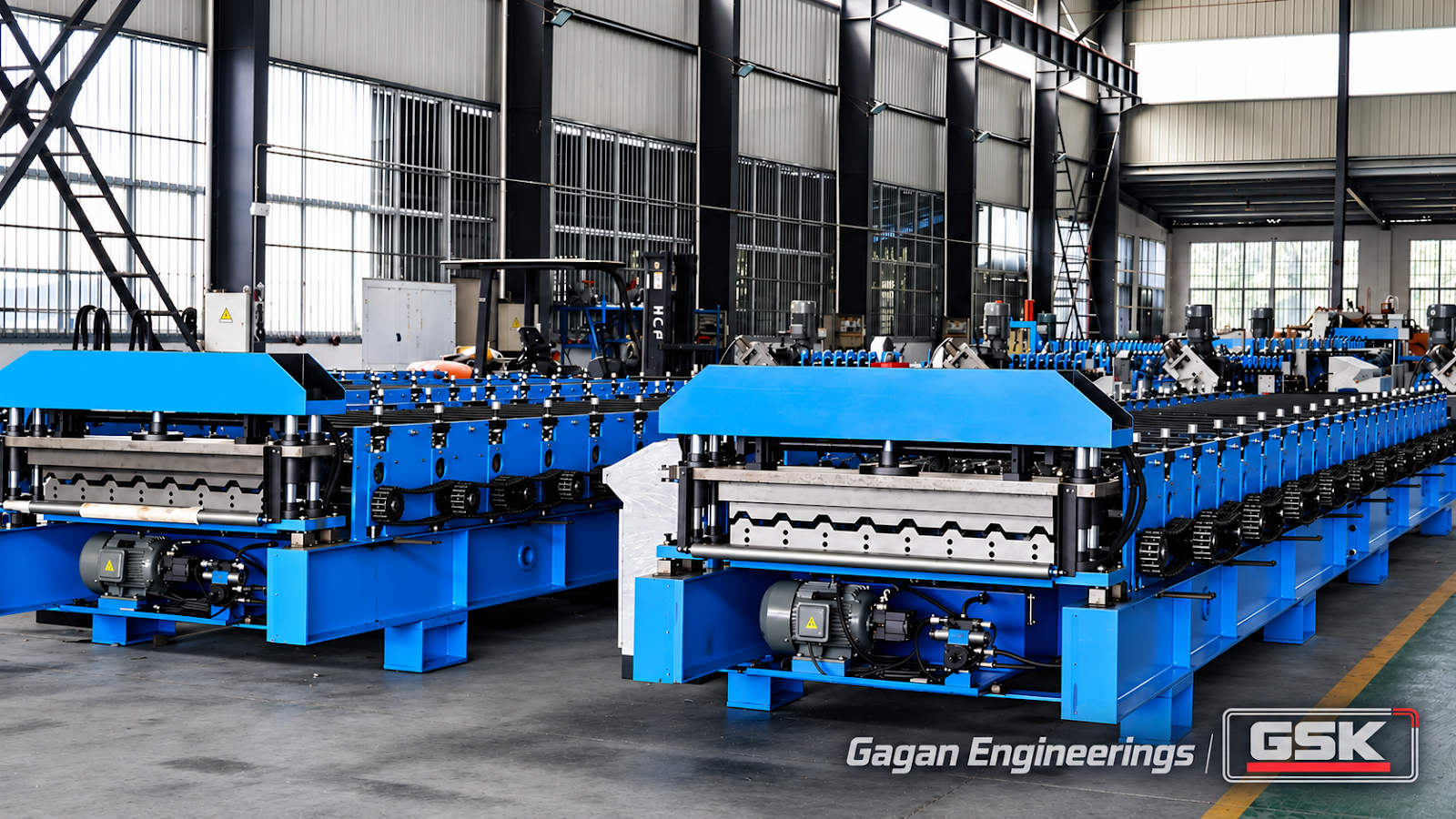
Explore automatic roofing sheet making machines priced ₹15–30 lakh at Gagan Engineering Works. Compare quality, specifications and buying options for 2026.
Roofing Sheet Making Machine Price in India — 2026 Overview
In India's industrial machinery market in 2026, the price of a standard industrial-grade automatic roofing sheet making machine generally ranges between ₹15,00,000 and ₹30,00,000 INR (₹15 Lakh to ₹30 Lakh) at Gagan Engineering Works. Across the broader Indian manufacturing sector, equipment prices can vary from approximately ₹10 Lakh for basic entry-level semi-automatic units up to ₹35 Lakh or more for heavy-duty, high-speed dual-profile or multi-station production lines.
This price variation reflects fundamental differences in mechanical engineering, component metallurgy, structural rigidity, automation level, forming speed, and long-term operating durability. At Gagan Engineering Works, based in Khopoli, Maharashtra, our automatic roofing sheet making machines are deliberately positioned in the upper-middle to premium industrial segment (₹15,00,000 – ₹30,00,000). We do not manufacture lightweight, cut-price machines built from scrap steel or unhardened mild steel rollers; nor do we market overpriced luxury foreign imports burdened with high tariffs and costly proprietary spare parts.
Our machinery is engineered specifically for commercial steel fabricators, Pre-Engineered Building (PEB) manufacturers, steel service centres, and industrial entrepreneurs who recognize that capital machinery must deliver uninterrupted two-shift production, micrometer forming precision, zero coil surface scratching on pre-painted (PPGI) stock, and a machine operational life exceeding 15 to 20 years.
A machine's purchase invoice is only the first chapter of its commercial lifecycle. Purchasing decisions driven solely by the lowest quotation frequently result in excessive coil scrap wastage, chronic hydraulic valve leakage, premature roller grooving, and catastrophic drive shaft deflection under heavy-gauge steel. In industrial roll forming, precision engineering and structural integrity consistently deliver a substantially lower Total Cost of Ownership (TCO) and rapid capital recovery.
Roofing Sheet Making Machine Price Comparison in 2026
| Machine Classification | Typical Forming Speed | Roll Forming Stations | Roller Metallurgy | Automation Architecture | Estimated Price Range (INR 2026) |
|---|---|---|---|---|---|
| Entry-Level Semi-Automatic Roll Former | 8 – 12 m/min | 12 – 14 Stations | Unhardened EN-8 / Mild Steel (Flash Chrome) | Push-button relay console or basic manual cutter | ₹10,00,000 – ₹13,50,000 |
| Standard Industrial Automatic GC / Tata Nali Line | 15 – 20 m/min | 16 – 18 Progressive Stations | Vacuum-Hardened EN31 / Cr12 Tool Steel (0.05 mm Chrome) | Delta / Siemens PLC Touchscreen + Optical Encoder | ₹15,00,000 – ₹20,00,000 |
| Heavy-Duty Industrial PEB Trapezoidal Rib Line | 18 – 25 m/min | 18 – 22 Progressive Stations | Cr12 Forged Die Steel (58–62 HRC, 0.05 mm Hard Chrome) | Delta / Siemens PLC HMI + Hydraulic Profile Shear | ₹18,00,000 – ₹25,00,000 |
| Specialized Dual-Profile / Double-Decker Line | 15 – 22 m/min | 28 – 36 Stations (Stacked) | Hardened Alloy Tool Steel with Dual Tooling Sets | Dual-Recipe PLC System with Independent Hydraulic Cutters | ₹24,00,000 – ₹32,00,000 |
| Automated Roofing Sheet Crimping Machine | 25 – 35 crimps/min | Hydraulic Stepping Jaw | Vacuum-Hardened Cr12 Alloy Steel Forming Dies | PLC Touchscreen with Curvature Radius Calculator | ₹4,50,000 – ₹7,50,000 |
| 10-Ton Motorized Hydraulic Decoiler Unit | Synchronized Infeed | Mandrel Expansion | Heavy-Duty Cast Wedge with Hydraulic Brake | Automatic Loop Sensor with Inverter Control | ₹4,50,000 – ₹6,50,000 |
Why Do Roofing Sheet Making Machine Prices Vary?
Prospective industrial machinery buyers frequently ask why two roll forming machines producing seemingly identical corrugated or trapezoidal roof sheets carry price tags that differ by ₹5,00,000 to ₹15,00,000. To the untrained eye, both machines feature a steel bed, a series of shiny rollers, an electric motor, and a hydraulic cutting blade. However, the true distinction lies inside the metallurgy, dimensional tolerances, structural dynamics, and electrical control systems.
Here are the primary engineering variables that govern machine pricing:
1. Machine Frame Rigidity and Bed Construction
The foundational frame must resist continuous cyclic torsion during roll forming. High-quality industrial machines utilize heavy structural steel channel (ISMC 250 or ISMC 300) with 20 mm to 25 mm thick side plates, fully stress-relieved and CNC line-bored in a single setup to ensure absolute axial alignment across all forming stands. Budget machines frequently substitute thin 100 mm to 150 mm fabricated channels or hollow rectangular tubing. Over 6 to 12 months of high-tonnage operation, these light frames flex, introducing permanent twist, camber, and edge wave into finished roofing sheets.
2. Number of Roll Forming Stations
Progressive metal displacement is the golden rule of roll forming. A classic 76 mm pitch sinusoidal wave (Tata Nali) or industrial PEB trapezoidal rib profile requires 16 to 22 progressive forming stations to gradually shape high-tensile steel (550 MPa) without exceeding the material's elastic limit. Budget manufacturers cut costs by reducing station counts to 12 or 14 stages. Forcing steel to deform across fewer passes creates excessive internal stress, resulting in severe sheet curvature, flared ends, and paint cracking along the rib crests.
3. Roller Metallurgy, Heat Treatment, and Hard Chrome Plating
The rollers directly contact high-speed steel coils. Premium machines employ forged EN31 bearing steel or high-carbon high-chromium Cr12 die steel, vacuum heat-treated to 58–62 HRC, precision CNC turned, and electroplated with 0.05 mm (50 microns) of micro-crack industrial hard chrome. Budget formers often use ordinary unhardened 45# carbon steel or EN-8 with a thin flash chrome coating (<10 microns). When processing abrasive hot-dip galvanized or color-coated coils, unhardened rollers wear within 6 to 9 months, creating dimensional inaccuracies and scraping paint coatings.
4. Solid Shaft Diameter and Material Grade
Shaft deflection is the number-one cause of profile inconsistency. Quality industrial machinery incorporates solid 70 mm, 75 mm, or 80 mm diameter shafts turned and cylindrical-ground from forged 40Cr alloy steel. Budget machines commonly cut costs by utilizing 50 mm to 60 mm shafts, sometimes made from unhardened mild steel. Under 0.50 mm or 0.60 mm sheet loading, undersized shafts deflect at their midpoints, causing loose center corrugations and inconsistent sheet overlap seams.
5. Drive Transmission Architecture
Delivering synchronized torque across 18+ stations requires heavy-duty mechanical transmission. High-grade lines utilize industrial helical geared speed reducers paired with heavy double-strand roller chains (1-inch or 1.25-inch pitch) and induction-hardened sprockets, or individual distribution gearboxes for continuous 24-hour service. Cheaper machines cut costs with light automotive-grade single chains, small worm reduction gearboxes, and open gear sets prone to rapid backlash and erratic speed synchronization.
6. Hydraulic Cutting Mechanism and Blade Metallurgy
Clean, burr-free sheet cutoff without edge deformation demands a heavy hydraulic cutting station. Quality machinery features Cr12MoV vacuum-hardened cutting dies (60–62 HRC) designed with accurate profile contours that cleanly shear through both ribs and valleys. The hydraulic station must incorporate high-pressure directional control valves (such as Yuken or Rexroth), a dedicated oil reservoir with level and temperature gauges, and continuous oil filtration to prevent overheating during long production shifts.
7. Industrial Automation, PLC Control, and Optical Encoders
Precision length accuracy (±1.0 mm on a 12-meter industrial sheet) requires advanced motion control. Industrial machines feature Delta, Siemens, or Mitsubishi programmable logic controllers (PLCs) paired with color touchscreen HMIs and high-resolution optical rotary encoders. Operators can program multi-batch production schedules, exact sheet lengths, and automated cutoff cycles. Lower-cost machines rely on rudimentary push-button relays and mechanical limit switches, which can vary by ±10 mm to ±25 mm depending on line speed and operator reflexes.
Why Gagan Engineering Works Automatic Machines Cost ₹15–30 Lakh
At Gagan Engineering Works, we deliberately price our automatic roofing sheet making machines between ₹15,00,000 and ₹30,00,000 INR based on machine model and configuration. This pricing reflects an uncompromising commitment to mechanical durability, precision manufacturing, and verifiable component quality.
Here is why our machinery represents compelling value for professional manufacturers:
1. Sourced and Manufactured in Maharashtra's Industrial Belt
Located in Khopoli, Maharashtra—surrounded by India's premier metallurgical, steel, and heavy fabrication clusters and just 65 km from Nhava Sheva (JNPT) container port—Gagan Engineering Works sources certified domestic alloy steels, heavy structural channels, and precision electrical drives. Every machine is manufactured, aligned, assembled, and trial-tested under one roof by mechanical engineers with over 19 years of practical roll forming experience.
2. Built for Two-Shift Continuous Commercial Production
Our roll formers are not experimental prototypes or light-duty workshop machines. They are designed for industrial manufacturers operating 12 to 16 hours daily. From solid 75 mm 40Cr forged shafts and vacuum-hardened EN31/Cr12 rollers to 7.5 HP–15 HP heavy geared drive motors and 5.0 HP–7.5 HP dedicated hydraulic power packs, every component is sized with safety factors exceeding 2.5x normal working loads.
3. Zero Paint Peeling Guarantee on PPGI / Galvalume Coils
Pre-painted galvanized iron (PPGI) and Galvalume (AZ150) coils are high-value raw materials costing ₹70 to ₹105 per kilogram. Even microscopic tooling tool marks or roller scuffing will scrape the polyester primer, leading to customer rejection and severe warranty liability. Our rollers undergo precision diamond mirror-polishing and 0.05 mm hard chrome deposition, guaranteeing flawless, scratch-free passage across every single wave crest and valley.
4. Cutting Tolerance Within ±1.0 mm per 10-Meter Sheet
Industrial PEB roofing contractors reject sheets with variable lengths because purlin alignment and screw fastening require exact panel dimensions. Our synchronized Delta/Siemens PLC motion control and heavy-duty optical encoders maintain consistent cutting tolerances of ±1.0 mm on 10-meter and 12-meter roofing panels, virtually eliminating edge-trim scrap on installation sites.
5. Comprehensive Component Transparency
We provide prospective clients with complete component transparency. When you order a Gagan Engineering Works machine, your quotation and technical specification sheet explicitly state the shaft diameter, roller steel grade, bearing brands, PLC model, and hydraulic valve manufacturers. We do not substitute generic unbranded parts under vague "standard specifications" clauses.
Budget vs Industrial-Grade Automatic Roofing Sheet Machines
| Engineering Parameter | Budget / Low-Cost Machine (₹10L – ₹13.5L) | Gagan Engineering Industrial Machine (₹15L – ₹30L) | Operational Impact on Factory Owners |
|---|---|---|---|
| Machine Base Frame | 100–125 mm light fabricated channel or hollow tube | ISMC 250 / 300 heavy structural channel with 20 mm plates | Prevents bed twisting; guarantees flat sheets over decades |
| Roll Forming Stations | 12 to 14 forming stages (rushed profile deformation) | 16 to 22 progressive forming stages | Eliminates edge flare, oil canning, and sheet camber |
| Roller Material & Finish | Unhardened 45# steel / EN-8 (<10 micron flash chrome) | Forged EN31 / Cr12 tool steel, 58–62 HRC, 0.05 mm hard chrome | Zero paint scratching on PPGI; 10+ year roller lifespan |
| Shaft Diameter & Grade | 50 mm to 60 mm commercial mild steel | 70 mm to 80 mm solid 40Cr forged alloy steel | Zero shaft deflection under 0.60 mm high-tensile steel |
| Cutting Blade Metallurgy | Standard EN-9 / mild steel with surface hardening | Cr12MoV vacuum-hardened die steel (60–62 HRC) | Over 300,000 clean cuts before requiring blade re-grinding |
| Hydraulic Power Unit | 3.0 HP unbranded pump with manual valves | 5.0 HP – 7.5 HP power pack with Yuken directional valves & cooler | Fast cycle speed, zero valve sticking, no oil overheating |
| Automation & Control | Relay logic / push button or entry-level controller | Delta / Siemens PLC color touchscreen with optical encoder | Exact length repeatability (±1.0 mm); multi-job memory |
| Average Monthly Downtime | 3 to 5 days per month (chain breaks, valve leaks, sensor faults) | Virtually zero unplanned mechanical downtime | Saves ₹1,00,000 – ₹2,50,000 in monthly idle capacity |
| Total 5-Year Maintenance Cost | ₹4,00,000 – ₹7,00,000 (roller replacement, rewiring, seals) | ₹60,000 – ₹1,20,000 (routine lubricants, oil filters, seal kits) | Higher initial investment is fully recouped through maintenance savings |
Types of Roofing Sheet Making Machines
The industrial roofing sector in India relies on specialized roll forming lines tailored to specific profile geometries, raw material gauges, and architectural applications. Before investing in machinery, buyers must match customer demand in their regional market with the appropriate machine configuration.
Here are the primary machinery categories manufactured and supplied by Gagan Engineering Works:
1. Corrugated GC Roofing Sheet Making Machine (Sinusoidal Tata Nali)
The traditional round-wave sinusoidal profile—universally known across India as *Tata Nali* or *Nali Patra* (nominal pitch 76 mm / 3 inches, depth 18 mm)—remains India's highest-volume metal roofing profile. Our Corrugated Sheets Making Machine features 16 to 18 progressive forming stations with 70 mm or 75 mm solid 40Cr shafts. It effortlessly shapes galvanized iron (GI), pre-painted galvanized iron (PPGI), and Galvalume coils from 0.15 mm to 0.80 mm gauge. Operating at line speeds of 15 to 20 meters per minute, this machine delivers high-speed throughput for rural housing, agricultural sheds, warehouse roofs, and perimeter barricades.
2. PEB Industrial Roofing Sheet Making Machine (Trapezoidal Rib Profile)
Pre-Engineered Buildings (PEB), modern commercial logistics hubs, and industrial manufacturing plants predominantly specify trapezoidal rib profiles with 1000 mm or 1050 mm effective cover width and deep 28 mm to 32 mm water-shedding ribs. Our PEB Roofing Sheet Making Machine incorporates 18 to 22 forming stations driven by an 11 kW (15 HP) motor with variable frequency drive (VFD). Engineered to process high-yield strength steel coils (up to 550 MPa), this heavy-duty line features hydraulic profile cutoff and precision automatic length indexing.
3. PPGI & Colour-Coated Roofing Sheet Making Machine
Architectural roofing demands vibrant aesthetics and zero surface defects. Processing pre-painted steel (PPGI) and aluminium-zinc alloy coated steel (PPGL) requires specialized tooling geometry to prevent paint stretching and cracking along acute bend radii. Our colour-coated sheet machines feature mirror-polished rollers coated with 0.05 mm hard chrome, polyurethane-coated entry feed guides, and non-marking outfeed conveyor tables to preserve finished coil coatings in pristine condition.
4. Curved Roofing Sheet Crimping Machine
Adding a Roofing Sheet Crimping Machine to an existing roll forming line enables the production of self-supporting curved arch panels. Widely used for barrel-vault warehouses, petrol pump canopies, stadium roofs, and decorative building eaves, crimping machines use a synchronized hydraulic stepping jaw to impart controlled indentations across trapezoidal ribs, achieving precise radius curvatures from 2.0 meters up to infinity.
5. Essential Supporting Equipment: Hydraulic Decoilers and CTL Lines
A roll forming line is only as productive as its infeed and outfeed material handling systems. Gagan Engineering Works manufactures matching auxiliary equipment:
• [10-Ton Hydraulic Decoiler](/products/10-ton-hydraulic-decoiler): Features hydraulic wedge mandrel expansion (480–520 mm inner diameter), motorized forward/reverse uncoiling, and an automatic pneumatic loop-control arm for seamless infeed of 10-metric-ton mother coils.
• [Automatic Cut-to-Length (CTL) Lines](/products/automatic-cut-to-length-ctl-line-guide): Incorporates multi-roll precision leveling machines and hydraulic high-speed shears to convert raw steel master coils into flat cut sheets with high flatness tolerances.
Technical Specifications to Check Before Purchasing
| Technical Parameter | Corrugated GC Sheet Machine | PEB Trapezoidal Rib Machine | Roofing Sheet Crimping Machine |
|---|---|---|---|
| Standard Supported Coil Width | 914 mm / 1000 mm / 1220 mm / 1250 mm | 1220 mm / 1250 mm Standard Coils | Up to 1250 mm Formed Profile Width |
| Material Gauge Capacity | 0.15 mm – 0.80 mm (GI / PPGI / Galvalume) | 0.30 mm – 0.80 mm (Up to 550 MPa Steel) | 0.30 mm – 0.80 mm (Trapezoidal / Corrugated) |
| Roll Forming Stations | 16 to 18 Progressive Stations | 18 to 22 Progressive Stations | Hydraulic Stepping Jaw Pressing Unit |
| Shaft Diameter & Material | 70 mm / 75 mm Solid 40Cr Alloy Steel | 75 mm / 80 mm Solid 40Cr Alloy Steel | Forged Alloy Steel Pivot & Ram Pins |
| Roller Metallurgy & Finish | Forged EN31 / Cr12 Tool Steel (58–62 HRC, 0.05 mm Chrome) | Forged Cr12 Die Steel (58–62 HRC, 0.05 mm Chrome) | Cr12 Vacuum Hardened Forming Dies |
| Main Drive Motor Power | 7.5 HP (5.5 kW) Geared Motor with VFD | 15.0 HP (11 kW) Geared Motor with VFD | 5.0 HP (3.7 kW) Stepper / Servo Feed Drive |
| Hydraulic Power Unit | 5.0 HP Power Pack (Yuken Valves) | 7.5 HP Power Pack (Integrated Oil Cooler) | 5.0 HP Heavy-Duty Hydraulic Unit |
| Shearing System | Hydraulic Profile Post-Cut (Cr12MoV Blade) | Hydraulic Profile Stop-Cut (Cr12MoV Blade) | Synchronized Stepping Blade / Press |
| Line Speed / Output | 15 – 20 meters per minute | 18 – 25 meters per minute | 25 – 35 crimps per minute |
| Cutting Length Accuracy | ± 1.0 mm per 10-meter panel | ± 1.0 mm on 12-meter industrial sheets | ± 0.2 mm Step Indexing Repeatability |
| Electrical Power Requirement | 415V, 3-Phase, 50 Hz (Connected Load ~12.5 HP) | 415V, 3-Phase, 50 Hz (Connected Load ~22.5 HP) | 415V, 3-Phase, 50 Hz (Connected Load ~7.5 HP) |
| Control System Console | Delta / Siemens PLC Color Touchscreen HMI | Delta / Siemens PLC Color Touchscreen HMI | Delta / Siemens PLC with Radius Calculator |
How Much Does Roofing Sheet Manufacturing Cost?
When planning an industrial roofing sheet manufacturing business, entrepreneurs must clearly distinguish between the machinery capital expenditure (CapEx) and the ongoing operating expenditure (OpEx). Purchasing an automatic roll forming machine in the ₹15,00,000 to ₹30,00,000 range represents approximately 25% to 35% of the total capital required to establish an operational manufacturing unit.
Here is an objective overview of the complete cost components for 2026:
1. Plant Machinery Investment (CapEx: ₹15,00,000 – ₹30,00,000)
This covers the core automatic roll forming line, including the infeed guiding assembly, progressive roller stations, hydraulic post-cut shear, PLC automation console, runout receiving tables, and standard tooling. Adding optional equipment like a 10-ton motorized hydraulic decoiler (₹4.5L–₹6.5L) or a curved sheet crimping machine (₹4.5L–₹7.5L) expands capabilities and margin potential.
2. Raw Material Steel Coils (Working Capital: ₹35,00,000 – ₹75,00,000)
Raw material coil inventory constitutes the largest ongoing working capital requirement. In 2026, prevailing ex-mill prices in India are:
• Galvanized Iron (GI) Coils (IS 277:2018): ₹55 to ₹75 per kg depending on zinc coating mass (Z80 to Z275 GSM).
• Pre-Painted Galvanized Iron (PPGI) Coils: ₹70 to ₹95 per kg depending on coating thickness and paint system.
• Galvalume / PPGL Coils (AZ150): ₹70 to ₹105 per kg for superior corrosion-resistant applications.
A healthy startup inventory of 50 to 100 metric tons ensures continuous order fulfilment without succumbing to weekly steel price fluctuations.
3. Factory Shed and Infrastructure (₹3,00,000 – ₹10,00,000 Startup / Lease)
A standard roofing roll forming line measures approximately 10 to 14 meters in length by 1.8 meters in width. Including coil storage, finished sheet stacking, loading bays, and material handling pathways, an operational plant requires 2,500 to 5,000 square feet of covered industrial shed space. A level concrete foundation (minimum 150 mm M20 grade reinforced concrete) is required to ensure vibration-free operation. Installing a 3-ton to 5-ton overhead EOT crane or gantry crane is highly recommended for efficient mother coil loading onto the decoiler.
4. Electrical Power and Utility Consumption
An automatic roofing line typically has a total connected electrical load of 12.5 HP to 22.5 HP (~9.5 kW to 17 kW). Operating on a standard 3-phase 415V 50 Hz industrial power connection, an 8-hour production shift consumes approximately 60 to 90 electrical units (kWh). At an average commercial power tariff of ₹8 to ₹11 per unit in Maharashtra and Gujarat, daily electricity expenses run between ₹600 and ₹1,000.
5. Manpower Requirements
Thanks to full PLC automation, an automatic line requires only one skilled machine operator to manage the touchscreen interface and coil feed, supported by two semi-skilled helpers at the discharge end for panel inspection, strapping, and bundling. Monthly labour expenses typically total ₹45,000 to ₹70,000 for a single shift.
How to Calculate Roofing Sheet Machine ROI
Industrial roll forming lines deliver some of the fastest capital payback timelines in the Indian steel processing sector. The commercial model operates primarily on conversion margins (job-work charges) or the margin spread between purchased master coils and finished retail roofing panels.
Here is a practical financial calculation framework based on realistic 2026 industry benchmarks:
Step 1: Production Volume and Throughput
Operating at a moderate line speed of 18 meters per minute, an automatic machine can form approximately 1,000 meters of finished roofing sheets per hour. Factoring in coil changeovers, length adjustments, bundling, and scheduled maintenance, a well-managed single 8-hour shift achieves an effective operating factor of 50% to 60%, yielding 2,500 to 3,500 running meters (equivalent to 15 to 20 metric tons of steel) per day.
Step 2: Conversion Margin Economics
In India's primary industrial zones, standard conversion charges for forming GI and PPGI coils range from ₹3,000 to ₹5,500 per metric ton (or a retail spread of ₹3 to ₹6 per running foot).
• Taking a conservative average margin of ₹3,500 per metric ton:
• Daily processing volume = 15 metric tons
• Daily Gross Margin = 15 MT × ₹3,500 = ₹52,500
• Operating on 26 working days per month:
• Monthly Gross Operating Income = 26 days × ₹52,500 = ₹13,65,000
Step 3: Deducting Monthly Operating Overheads
• Industrial shed lease (3,500 sq.ft): ₹70,000 – ₹1,20,000
• Electricity and utilities: ₹25,000 – ₹35,000
• Operator and helper wages (3 personnel): ₹55,000 – ₹75,000
• Consumables (hydraulic oil top-ups, grease, strapping, packaging): ₹20,000 – ₹35,000
• Equipment depreciation and preventive maintenance reserve: ₹30,000 – ₹50,000
• Commercial interest and administration: ₹60,000 – ₹90,000
• Total Monthly Operating Overheads = Approx. ₹2,60,000 – ₹4,05,000
Step 4: Net Monthly Cashflow and Payback Horizon
• Net Monthly Cashflow = Monthly Gross Income (₹13,65,000) – Operating Overheads (₹3,65,000) = ₹10,00,000 Net Profit / Month
• Against an initial capital machinery investment of ₹18,00,000 to ₹25,00,000 for a complete automatic line:
• Machinery Payback Period = 2.0 to 2.5 months of consistent single-shift commercial production.
Even under conservative scenarios operating at just 40% capacity utilization (6 to 8 metric tons per day), the capital cost of a Gagan Engineering Works automatic roofing sheet making machine is completely recovered within 4 to 6 months, establishing a permanent, high-margin manufacturing asset for your business.
Fully Automatic vs Semi-Automatic Roofing Sheet Machines
When evaluating machinery investments, prospective buyers often deliberate between semi-automatic and fully automatic roll forming lines. While semi-automatic machines carry a lower initial purchase price (typically ₹10L–₹13.5L), they impose significant operational penalties in throughput, cut length consistency, and labor overheads.
1. Material Feeding and Uncoiling
In a semi-automatic setup, coils are loaded onto basic manual mechanical decoilers. Operators must manually crank the brake to adjust tension. In a fully automatic Gagan Engineering line, the motorized hydraulic decoiler expands hydraulically, automatically detects coil slack via sensor loops, and feeds material smoothly into the roll former without operator intervention.
2. Length Measurement and Profiling Speed
Semi-automatic machines rely on manual mechanical stop-bars or mechanical trip switches. As forming speed increases, inertia causes the sheet to overshoot the switch, leading to length variations of ±10 mm to ±25 mm. Fully automatic lines employ high-resolution optical rotary encoders coupled with the PLC. The controller continuously monitors sheet speed, decelerates smoothly as the target length approaches, and triggers the hydraulic shear with ±1.0 mm precision.
3. Shearing Cycle and Cycle Efficiency
Semi-automatic lines require an operator to manually press a foot pedal or pull a hydraulic control lever for every individual sheet cut. On an 8-hour shift producing 1,000 sheets, this requires 1,000 repetitive operator interventions, introducing fatigue, slow cycles, and dangerous manual operations. Fully automatic lines execute automated "stop-to-cut" or "flying shear" cycles automatically, cycling in 1.5 to 2.5 seconds with zero operator intervention.
4. Production Output Comparison
A semi-automatic roll forming line rarely exceeds 300 to 500 finished panels per 8-hour shift due to operator bottlenecks and handling delays. In contrast, an automatic PLC-controlled line comfortably outputs 800 to 1,200 standard 10-foot or 12-foot sheets per shift, more than doubling the factory's revenue-generating capacity with fewer personnel.
How to Choose the Best Roofing Sheet Making Machine Manufacturer in India
Selecting a machinery manufacturing partner is one of the most critical business decisions an industrial entrepreneur will make. With dozens of equipment fabricators across Maharashtra, Gujarat, Punjab, and Tamil Nadu, buyers must conduct thorough engineering due diligence to separate reputable machinery manufacturers from unorganized workshop traders.
Use this objective checklist when evaluating prospective manufacturers:
1. Conduct an In-Person Factory and Workshop Audit
Never purchase heavy industrial roll forming machinery solely from a digital brochure or telephone quotation. Visit the manufacturer's workshop. Inspect their fabrication infrastructure. Do they operate heavy-duty lathe machines, radial drill presses, CNC machining centers, and precision grinding machines in-house? Or do they merely outsource cheap parts and assemble them in a rented shed?
2. Insist on a Live Factory Trial Run Using Your Test Coils
A reputable manufacturer will welcome live pre-dispatch machine testing. Provide 200 to 300 meters of your preferred raw material—especially 0.35 mm or 0.45 mm high-tensile PPGI or Galvalume coil. Run the machine continuously for at least 30 minutes. Measure:
• Profile depth and pitch consistency across all corrugations using digital vernier calipers.
• Cutting length repeatability across at least 10 consecutive panels.
• Inspect the paint surface on PPGI under bright industrial lighting to verify zero scuffing, micro-cracking, or protective film tears.
3. Inspect Shaft Runout with a Dial Gauge Indicator
During the workshop inspection, attach a magnetic-base dial test indicator (DTI) to the machine bed and touch the probe against the center of the shafts while rotating them. Shaft runout must remain strictly within 0.02 mm to 0.03 mm. Any shaft showing visible runout or deflection before shipment will fail under continuous commercial loads.
4. Demand Written Component Brand Transparency
Ensure your commercial contract specifies exact component grades. Reject vague terms like "standard PLC" or "high-grade steel." Demand written confirmation of:
• Shaft material (e.g., Solid 40Cr Forged Alloy Steel).
• Roller steel grade (e.g., EN31 / Cr12 Tool Steel with 0.05 mm hard chrome).
• PLC / HMI make (e.g., Delta / Siemens).
• Hydraulic valves (e.g., Yuken / Polyhydron).
5. Verify Spare Parts Availability and On-Site Commissioning
Roll forming machines require occasional spare parts over their 15-year lifecycle—such as optical encoder wheels, hydraulic seals, proximity sensors, and shear blades. Confirm that the manufacturer maintains a permanent stock of interchangeable spares and provides on-site foundation drawings, electrical commissioning, and hands-on operator training at your factory location.
Why Consider Gagan Engineering Works?
For businesses seeking precision engineering, verifiable component quality, and dependable manufacturing support, Gagan Engineering Works in Khopoli, Maharashtra offers an established track record in industrial machinery manufacturing.
1. Strategic Manufacturing Location in Khopoli, Maharashtra
Our manufacturing facility is situated in Khopoli's heavy industrial corridor, adjacent to the Mumbai-Pune Expressway and just 65 km from Nhava Sheva (JNPT) container port. This provides seamless logistical access for heavy transport trailers servicing Maharashtra, Gujarat, Goa, Karnataka, Madhya Pradesh, and domestic industrial hubs across India, as well as export shipments to the Middle East, Africa, and Southeast Asia.
2. Over 19 Years of Specialized Engineering Heritage
Since 2006, our engineering team has designed, fabricated, and commissioned hundreds of industrial roll forming lines, heavy hydraulic decoilers, automated cut-to-length lines, and sheet metal processing systems. We understand the physical behavior of high-tensile steel, springback dynamics, and profile forming tolerances.
3. Direct Engineering Consultation — No Middlemen
When you consult with Gagan Engineering Works, you speak directly with machine designers and workshop engineers—not commissioned sales agents. We evaluate your target roofing profile, expected coil gauges, factory shed dimensions, and budget to configure a line that maximizes commercial ROI.
4. Comprehensive Factory Acceptance Testing (FAT)
Every machine manufactured at our Khopoli workshop undergoes rigorous factory testing before dispatch. We encourage clients to attend pre-dispatch trials to inspect machine operation, verify electrical interlocks, test hydraulic cutoff accuracy, and approve finished panel samples before releasing final transport clearances.
How to Request an Automatic Roofing Sheet Machine Quotation
To receive an accurate, customized technical proposal and machinery quotation from Gagan Engineering Works, providing clear specifications accelerates the engineering review process.
When contacting our engineering desk, please prepare the following details:
1. Desired Roofing Profile & Geometry
Specify whether you require a standard sinusoidal corrugated profile (Tata Nali / round wave: 76 mm pitch, 18 mm depth), an industrial PEB trapezoidal rib profile (1000 mm / 1050 mm effective cover width), a liner sheet profile, or a specialized custom architectural profile. Providing a cross-sectional CAD drawing or a dimensioned sketch ensures exact tooling calculations.
2. Raw Material Coil Specifications
• Material types to be processed: Galvanized Iron (GI), Pre-Painted Galvanized Iron (PPGI), Pre-Painted Galvalume (PPGL), or Aluminium.
• Sheet thickness range: e.g., 0.18 mm to 0.50 mm (light gauge) or 0.30 mm to 0.80 mm (heavy-duty structural gauge).
• Mother coil width: 914 mm, 1000 mm, 1220 mm, or 1250 mm.
3. Desired Production Capacity and Line Speed
Indicate your expected single-shift production volume (e.g., 10 to 15 MT/day or 20+ MT/day) and whether your application requires standard line speeds (15–20 m/min) or high-speed continuous output.
4. Required Line Auxiliaries
Specify if your order should include a matching 5-Ton manual or 10-Ton motorized hydraulic decoiler, an automatic roofing sheet crimping machine, automatic hydraulic stacker tables, or an upstream cut-to-length (CTL) shearing line.
5. Factory Destination and Electrical Supply
Indicate your installation city/state and confirm your factory's electrical supply parameters (standard Indian industrial supply is 415V, 3-Phase, 50 Hz; custom voltages such as 220V 3-phase or 380V 60 Hz are readily configured for export clients).
To submit your requirements directly, utilize the quotation form below or reach our technical desk via phone/WhatsApp at +91 83294 65245 or email gaganengineerings@gmail.com.
Frequently Asked Questions
Here are concise, factual answers to the most common technical and commercial questions prospective buyers ask regarding automatic roofing sheet making machines in India in 2026:
- What is the price of an automatic roofing sheet making machine in India in 2026?
In India, industrial-grade automatic roofing sheet making machines generally cost between ₹15,00,000 and ₹30,00,000 INR depending on profile type, station count, shaft diameter, and automation features. Entry-level semi-automatic models start around ₹10,00,000, while specialized high-speed or double-decker lines can reach ₹32,00,000 or more. - How much does a Gagan Engineering Works automatic roofing sheet machine cost?
At Gagan Engineering Works, our automatic roofing sheet making machines are positioned in the ₹15,00,000 to ₹30,00,000 range. This pricing reflects heavy structural ISMC frames, solid 70–80 mm 40Cr shafts, vacuum-hardened EN31/Cr12 tool steel rollers (58–62 HRC) with 0.05 mm hard chrome, and Delta/Siemens PLC automation. - What is included in the ₹15,00,000 to ₹30,00,000 machinery price?
A standard quotation includes the complete roll forming machine bed with 16 to 22 progressive forming stations, manual/motorized infeed guides, hydraulic post-cut profile shear station with Cr12MoV blades, hydraulic power pack with directional valves, PLC touchscreen control console with optical encoder, and outfeed sheet receiving tables. - Why do some roofing sheet machines cost only ₹8 to ₹12 lakh?
Lower-priced machines reduce manufacturing costs by using unhardened mild steel (45# or EN-8) rollers with thin flash chrome, undersized 50–60 mm mild steel shafts that flex under heavy coils, lightweight fabricated frames (ISMC 100), fewer forming stations (12–14), and basic push-button relay controls lacking PLC accuracy. - Can an automatic roofing sheet machine process PPGI and Galvalume coils without scratching?
Yes. Machines equipped with vacuum-hardened EN31 or Cr12 forged steel rollers plated with 0.05 mm hard chrome and mirror-polished contours will form pre-painted (PPGI) and Galvalume coils with zero surface scratches, scuffing, or micro-cracking of the paint finish. - What is the cutting length accuracy of the hydraulic post-cut shear?
Equipped with a Delta or Siemens PLC and a precision optical rotary encoder, the hydraulic cutoff shear delivers consistent length accuracy within ±1.0 mm per 10-meter or 12-meter industrial sheet, preventing edge-trim wastage during site installation. - What electrical power supply is required to run the machine?
A complete automatic roll forming line requires a standard 3-phase 415V, 50 Hz industrial power supply with a total connected load of approximately 12.5 HP to 22.5 HP (7.5–15 HP main drive motor + 5.0–7.5 HP hydraulic power pack). Export units can be built for 220V or 380V 60 Hz supplies. - How much factory shed space is needed for a roofing sheet machine?
The machine line itself occupies approximately 10 to 14 meters in length by 1.8 meters in width. To allow adequate space for mother coil unloading, decoiler feeding, sheet runout, bundling, and forklift/crane movement, a factory shed of 2,500 to 5,000 square feet is recommended. - What is the production speed and daily output capacity?
Standard industrial lines operate at 15 to 25 meters per minute. A single 8-hour shift typically outputs 2,500 to 3,500 running meters of finished roofing sheets, equivalent to approximately 15 to 20 metric tons of steel throughput per day. - How long do hardened roll forming rollers last before requiring maintenance?
Rollers manufactured from vacuum-hardened EN31 or Cr12 tool steel (58–62 HRC) with 0.05 mm hard chrome will typically operate for 8 to 12 years under standard 2-shift commercial production before requiring re-polishing or re-chroming. - Can a single machine produce both corrugated (Tata Nali) and trapezoidal PEB profiles?
No. The roller contours are profile-specific. To produce both profiles, manufacturers invest either in two separate dedicated lines or a specialized double-decker (stacked two-in-one) roll forming machine that shares a common frame and drive mechanism. - What is the difference between an automatic machine and a semi-automatic machine?
Semi-automatic machines require manual lever actuation for cutting and rely on mechanical limit switches with ±10–25 mm length variance. Automatic machines utilize PLC controllers and encoders to automatically measure length, decelerate, and shear sheets at high speed with ±1.0 mm precision. - What regular maintenance is required on an automatic roofing machine?
Routine maintenance involves weekly lubrication of drive chains and shaft bearings with EP2 grease, checking hydraulic oil level and filter cleanliness monthly, and periodically inspecting shear blade sharpness and encoder wheel alignment. - What should be inspected during an in-person factory trial run before shipment?
Verify smooth rotation without vibration, check shaft runout with a dial indicator (<0.03 mm), inspect finished panel dimensions with vernier calipers, verify cutting length accuracy across 10 consecutive cuts, and check PPGI coil surfaces for zero paint marks under bright lighting. - Where is Gagan Engineering Works located and do you deliver across India?
Gagan Engineering Works is located in Khopoli, Maharashtra, situated along the Mumbai-Pune industrial corridor and 65 km from Nhava Sheva (JNPT) port. We deliver, install, and commission machinery across all Indian states and export internationally. - How do I request a customized quotation for my specific roofing sheet profile?
Contact our engineering team with your required sheet profile drawing, coil width (e.g., 1220 mm), thickness range (e.g., 0.25–0.60 mm), and daily production target via phone/WhatsApp at +91 83294 65245 or email gaganengineerings@gmail.com.
Final Recommendation — Investing in High-Quality Automatic Machinery
In the capital machinery sector, the adage "you get what you pay for" holds absolute mechanical truth. A roofing sheet making machine is not a short-term consumable expense; it is a foundational income-generating asset expected to process tens of thousands of metric tons of high-value steel over a 15- to 20-year working life.
Choosing a machine positioned in the ₹15,00,000 to ₹30,00,000 INR range from Gagan Engineering Works protects your business from the costly pitfalls of lightweight, cut-price equipment. By investing in solid 70–80 mm 40Cr forged shafts, vacuum-hardened EN31/Cr12 tool steel rollers with 0.05 mm hard chrome, heavy ISMC structural frames, and Delta/Siemens PLC motion control, you secure:
• Flawless, scratch-free surface quality on high-margin PPGI and Galvalume coils.
• Precise length tolerances within ±1.0 mm, eliminating customer disputes and site trim scrap.
• Consistent, high-speed output of 15 to 20 metric tons per shift with zero chronic mechanical breakdowns.
• A rapid capital payback timeline of 2 to 4 months of steady production.
Whether you are launching a new roofing sheet manufacturing enterprise or expanding an existing steel service center in Maharashtra, Gujarat, or anywhere across India, our technical engineering team in Khopoli is ready to assist you with tailored machinery layouts, customized profile tooling, and transparent commercial quotations.