1.5-Inch vs 3-Inch Tube Mill Machines: OD Sizing, Cost Factors & Buying Guide
Published: 2026-10-08 | By Gagan Engineerings
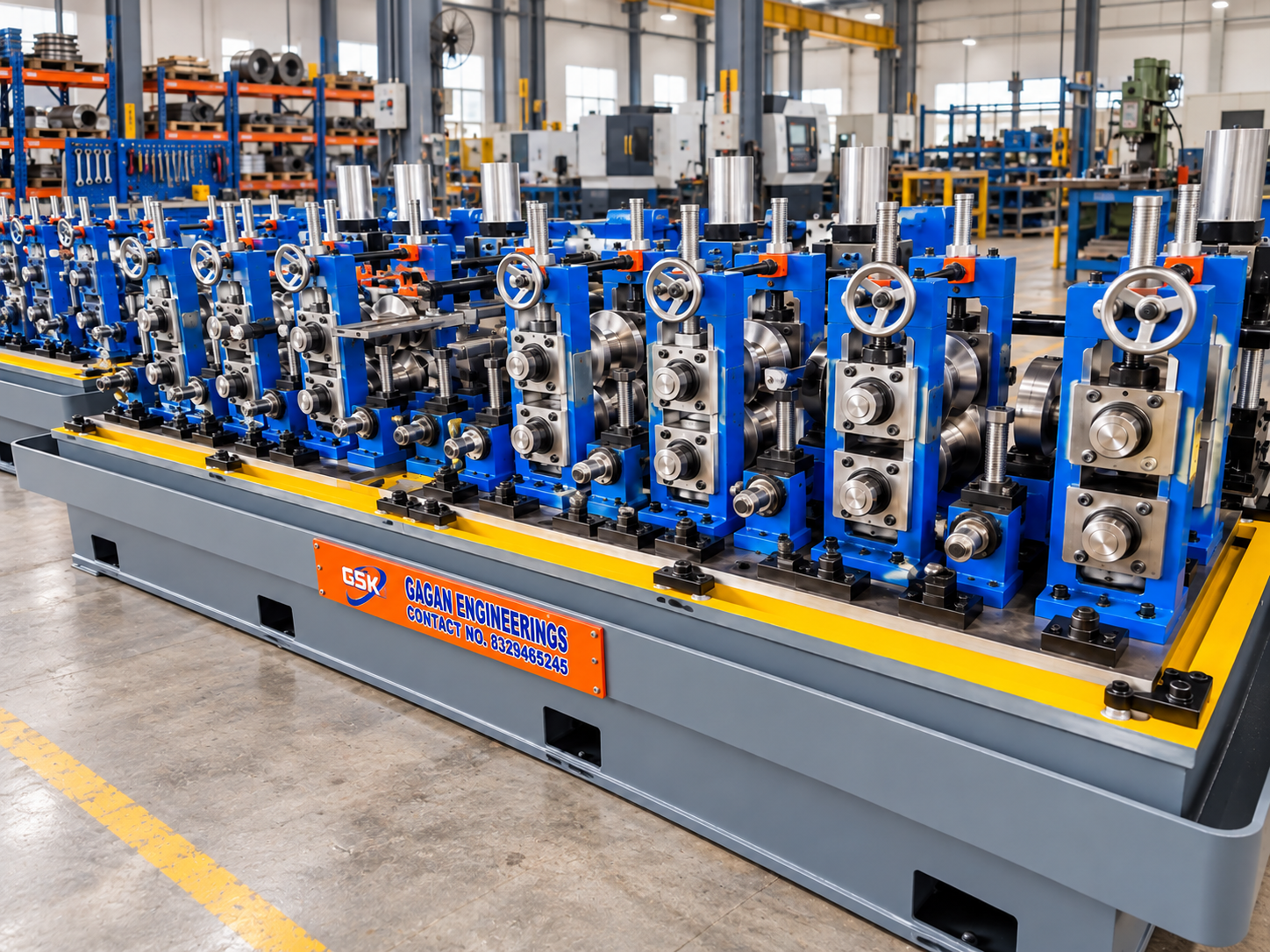
A practical comparison of OD-labelled tube mill configurations, product specifications, tooling, quotation scope, running costs and acceptance trials for Indian and export buyers.
Overview
A 1.5-inch or 3-inch tube mill should be selected from the finished tubes you intend to sell, not from the machine label alone. For Gagan Engineering Works, these inch labels refer to outside diameter (OD): 1.5 inches equals 38.1 mm, and 3 inches equals 76.2 mm. Gagan also offers customization for round, square, and rectangular tube production. The dimensions, thicknesses, materials, tooling, and equipment for a particular line must be agreed in its quotation.
That distinction matters when comparing tube mill machines. An OD label does not tell you the full production range. It does not establish the largest square section, the rectangular aspect ratios, or the wall thickness the machine can produce. It also cannot tell you whether a quoted price covers a complete production line or only part of one.
This guide explains how to turn your tube requirements into a useful specification, compare quotations, assess operating costs, and define a production trial before ordering.
What do 1.5-inch and 3-inch tube mill labels mean?
An inch is exactly 25.4 mm. The conversions below describe the two stated round OD labels; they are not a specification for every product the machine can make.
Round OD labels: inches and millimetres
| Selection question | 1.5-inch tube mill | 3-inch tube mill |
|---|---|---|
| What does Gagan's inch label refer to? | Tube outside diameter | Tube outside diameter |
| Exact metric conversion of the label | 38.1 mm OD | 76.2 mm OD |
| Can shape customization be discussed? | Round, square, and rectangular configurations | Round, square, and rectangular configurations |
| Does the label establish a complete size range? | No; specify and confirm each required product | No; specify and confirm each required product |
| Does it establish wall thickness, material, or production speed? | No; these require a configuration-specific agreement | No; these require a configuration-specific agreement |
Outside diameter versus nominal pipe size
Outside diameter and nominal pipe size are different descriptions. A customer may order tubing by its measured OD, while a pipe specification may use a nominal designation. Do not assume that a pipe described as “1.5-inch” has a measured OD of 38.1 mm. Ask which dimensional standard applies and record the actual OD, wall thickness, and tolerances.
For square and rectangular tubes, write the outside dimensions explicitly. A 3-inch round OD label does not mean that a line produces a 3-inch square tube. Square side dimensions, rectangular width and height, corner geometry, wall thickness, and the forming route need their own confirmation. Converting the circle label into a square dimension would hide these engineering constraints.
Start with a product matrix, not a machine quotation
Before asking for a tube mill machine price, list the finished products that will generate your business. Separate immediate requirements from possible future products. Otherwise, a quotation may include unnecessary equipment while missing the tooling needed for your main orders.
For each product, record:
- Shape: round, square, or rectangular.
- Finished outside dimensions and wall thickness.
- Material specification, grade, and surface condition.
- Cut length, dimensional tolerances, and end requirements.
- Intended application and applicable finished-tube standard.
- Monthly saleable quantity and typical batch size.
- Required tests, marking, packing, and documentation.
Give the manufacturer examples of both your highest-volume product and your most demanding product. The latter might have a difficult thickness-to-size relationship, stricter surface requirements, or an unusual rectangular shape. Engineering should evaluate these combinations rather than approve dimensions and thicknesses as separate lists.
Include the coil information you can actually source: material grade, thickness tolerances, slit width, coil weight, coil inside diameter, and coil outside diameter. Coil-handling equipment and strip preparation must suit that supply. A line cannot achieve consistent finished-tube quality if the incoming material varies beyond its agreed requirements.
This matrix also makes quotation comparisons fairer. Two manufacturers quoting different material grades, tooling quantities, or output conditions are not quoting the same production task.
When should you choose a 1.5-inch or 3-inch configuration?
Choose the configuration that covers the verified products you need, at the required quality and saleable output, with an acceptable ownership cost.
If your intended round products center on the 38.1 mm OD label, a 1.5-inch configuration is a sensible starting point for discussion. If they center on the 76.2 mm OD label, begin with a 3-inch configuration. Neither starting point establishes a minimum or maximum capacity; the manufacturer must confirm the required product matrix.
Do not assume that a larger-labelled mill automatically makes every smaller tube economically. Check its approved minimum dimensions, tooling, material limits, changeover requirements, and demonstrated performance on your smaller products. Equally, do not assume a smaller-labelled machine can be expanded later simply by changing rolls. Expansion may involve the forming stands, drive system, welding equipment, sizing section, cutoff, or other components.
Evaluate your order pattern as well as dimensions. A factory running one product for long batches has different needs from a factory switching sizes several times a shift. Tool accessibility, setting procedures, changeover time, startup scrap, and operator training can influence the buying decision as much as the headline running speed.
Ask the supplier to identify which requirements the base configuration covers, which need optional equipment, and which lie outside the proposed scope. A clear exclusion is more useful than an unsupported “all sizes” promise.
Understand the production route and supplied equipment
Many coil-fed welded tube lines include strip handling, forming, welding, sizing, and cutting, but the arrangement and technology vary. International manufacturers describe different forming systems and welding options: Fives' OTO overview illustrates a line with separate subsystems, while Formtek's tube and pipe mill overview discusses welding choices according to the application. These are useful process references, not specifications for Gagan's equipment.
For your proposed line, ask for a layout and an explanation of each stage:
1. Coil loading and uncoiling: how the coil is loaded, held, and fed; agreed coil dimensions and weight; and required handling arrangements.
2. Strip preparation and joining: how coil ends are prepared and joined, where applicable, and what happens to production during a coil change.
3. Accumulation: whether an accumulator is included and how its usable storage relates to the intended running conditions.
4. Forming: how flat strip becomes the required section and which rolls, guides, and settings control that process.
5. Welding, if part of the proposed process: the specified welding method, equipment, cooling requirements, and quality checks.
6. Sizing and straightening: how finished dimensions, shape, and straightness are adjusted and checked.
7. Cutoff and discharge: cutting method, supported lengths, end condition, handling, and packing arrangements.
Confirm the actual equipment supplied at every stage. A description of a typical tube mill line does not prove that a decoiler, accumulator, welder, testing system, or bundling system is included in a particular offer.
Round, square, and rectangular tube customization
Manufacturers use different methods for producing sections. Some configurations form a round section before reshaping it; others use a different forming route. FD Machinery's direct square and rectangular forming page demonstrates why the method should be stated rather than assumed.
Ask Gagan to confirm the route proposed for your section matrix, the tooling supplied, and the changes required between products. Establish whether new sizes require additional roll sets, guides, setup components, or a change to the line configuration. Agree the finished corner and seam requirements where they matter to your customers.
Customization should become a written equipment and tooling schedule. “Round, square, and rectangular” is a useful starting capability discussion; the schedule makes it a purchase specification.
Compare quotations using the same scope
There is no useful universal price for a 1.5-inch or 3-inch tube mill without a defined scope. A bare mill and a complete installed line can have substantially different responsibilities and equipment.
Use this worksheet when comparing tube mill manufacturers in India or overseas. Download the tube mill RFQ checklist to record the same requirements against each offer:
Quotation comparison worksheet
| Quotation section | What to ask the supplier to confirm |
|---|---|
| Product capability | Approved shape, dimension, thickness, and material combinations |
| Coil entry | Loading equipment, uncoiler, coil limits, strip preparation, joining, and accumulation |
| Main mill | Forming and sizing equipment, drives, controls, guards, and supplied adjustment systems |
| Welding | Process, supplied equipment, utilities, consumables, and inspection responsibilities |
| Tooling | Named product sizes covered, number of sets, material specification, and additional-set pricing |
| Cutting and discharge | Cutting method, length capability, expected end condition, collection, and packing scope |
| Site requirements | Layout, foundations, electrical supply, cooling, compressed air, and lifting needs |
| Installation | Responsibility for erection, alignment, commissioning, travel, accommodation, and training |
| Support | Documentation, recommended spares, service arrangements, warranty terms, and exclusions |
| Commercial terms | Currency, taxes, packing, freight, delivery term, payment milestones, and acceptance conditions |
Confirm exclusions and delivery milestones
Get exclusions in writing. For example, an electrical connection, cooling arrangement, lifting equipment, or foundation may be the buyer's responsibility even when the machinery is supplied as a line.
Compare delivery schedules with the same starting event: order acceptance, advance payment, drawing approval, or another agreed milestone. Clarify what happens if tooling or the product matrix changes after approval. Ask for the warranty wording rather than relying on a verbal summary.
Running speed is not the same as saleable output
A speed figure is useful only with its test conditions. Ask which material, dimensions, thickness, welding settings, cut length, and quality requirements produced it. Also ask whether the figure represents a brief demonstration, an operating recommendation, or an agreed acceptance condition.
Your business needs accepted tubes, not merely metres passing through the line. Saleable output depends on productive running time, changeovers, coil changes, startup material, rejected pieces, cutting losses, and inspection results.
For a rough planning calculation, a round steel tube's theoretical mass per metre can be estimated from:
Mass per metre (kg/m) = π × (D × t − t²) × ρ × 10⁻⁶
Here, D is outside diameter in millimetres, t is wall thickness in millimetres, and ρ is material density in kg/m³. This comes from the annular cross-sectional area. Use the correct density and actual dimensions for the material concerned. The hollow round-section model requires 0 < t < D/2.
Illustrative buyer calculation, not Gagan machine performance: assume a 38.1 mm OD round steel tube, 1.2 mm wall, density of 7,850 kg/m³, and an assumed running speed of 30 m/min. The theoretical mass is about 1.092 kg/m. If a scheduled eight-hour shift contains 360 minutes of productive running and 95% of the produced mass is accepted, estimated accepted output is:
1.092 × 30 × 360 × 0.95 ≈ 11,200 kg, or 11.2 tonnes.
The speed, thickness, productive time, and acceptance rate in this example are hypothetical inputs, not promised capacities. Use measured trial results for purchasing. The formula does not establish forming or welding capability, account for every material loss, or replace weighing accepted production. Do not use it unchanged for square or rectangular sections.
Calculate operating costs before discussing payback
Ask for an operating-cost model using your local prices and production mix. A credible estimate separates costs you can measure from assumptions that still need a trial.
Include coil material, electricity, labour, welding and cutting consumables where applicable, tooling upkeep, maintenance, cooling, packing, and waste handling. Add installation, financing, insurance, and other ownership costs separately so they remain visible. Record scrap recovery value instead of treating rejected material as either entirely worthless or entirely recovered.
Useful comparisons include energy per accepted tonne, labour cost per accepted tonne, and conversion cost per accepted tonne. State whether conversion cost excludes raw material. Use the same boundary when comparing machines or quotations.
Avoid deriving profit from machine capacity alone. Profit also depends on orders, selling price, purchased steel price, credit terms, rejects, working capital, and downtime. Model a realistic case and a lower-utilization case before deciding. A fixed payback promise without those inputs offers little help to an actual factory owner.
Use a factory acceptance test to verify the purchase
A factory acceptance test, or FAT, should demonstrate the agreed configuration using identified material and products. Define it before ordering so that both sides know what will be measured. The tube mill production-trial record provides a blank worksheet for those observations; it is not a certificate or proof of a completed test.
The trial record should capture material grade and thickness, finished dimensions, tooling, operating settings, run duration, total output, accepted output, rejects, and the inspection method. Agree the sampling plan and tolerances against your applicable product requirements.
Check the characteristics that matter to your customers: dimensions, wall thickness, cut length, straightness, surface condition, seam position, and weld quality where applicable. Specify any required destructive or non-destructive tests and who will perform them. Do not treat a visually neat tube as proof that it meets a particular standard.
Observe a representative changeover when multiple sizes are important. Record where timing starts and ends, how many people participate, and when acceptable production resumes. Watch coil handling, setup access, maintenance access, guarding, and emergency-stop demonstrations under the agreed safety procedure.
Photographs and video are strongest when accompanied by this record. Show the actual line, the product being made, a finished-tube measurement, and relevant process stages. A running video supports buyer understanding; a measured trial connects it to a purchasing decision.
Questions for export buyers
Export procurement adds site and delivery responsibilities that should be settled before shipment. Our industrial machinery export guide explains the wider logistics questions; confirm the terms offered for your particular tube mill. Provide your installation country, destination, electrical supply voltage and frequency, available cooling and compressed air, factory access, and layout constraints.
Ask who is responsible for export packing, loading, freight, insurance, import clearance, unloading, erection, and commissioning. State a precise Incoterms® rule, version, and named place where applicable, and make sure the contract explains responsibilities beyond the delivery term. Confirm any travel, visa, accommodation, and interpreter requirements for installation personnel.
Request packing dimensions, weights, handling points, drawings, operating manuals, electrical documentation, spare-parts identification, and the agreed training scope. Establish the support channel, response arrangements, time-zone practicalities, and how replacement parts will be identified and shipped.
Check local machinery requirements with the appropriate advisers and authorities. A supplier's general statement about export capability does not establish compliance in every destination. Any certification claim should identify the exact equipment, scope, issuing body, and supporting document.
Frequently asked questions
Answers to common tube-mill selection and quotation questions.
Is a 1.5-inch tube mill always limited to one round size?
The label alone does not answer that. Gagan uses it as an OD description. Ask for the approved production range and the tooling required for each product in your matrix.
Does a 3-inch tube mill make a 3-inch square tube?
That cannot be inferred from a round OD label. Square outside dimensions, corners, wall thickness, material, and forming configuration need separate engineering confirmation.
Can the same line make round, square, and rectangular tubes?
Gagan offers customization for these shapes. Confirm the exact combinations in your order, the forming route, included tooling, and the changeover process before treating them as supplied capability.
Which tube mill is better for a new factory?
Start with the products you can sell, available material, required accepted output, site utilities, and budget. The better choice is the configuration that meets those requirements with demonstrated quality and manageable ownership costs.
Can one machine process different metals or grades?
Only within its approved configuration. Do not assume a line specified for one material also covers another. Ask about material grade, strength, thickness, surface condition, welding process, and tooling implications.
What determines a tube mill machine's price?
Product capability, line equipment, tooling, welding and cutoff arrangements, controls, installation, support, and commercial terms all affect the quotation. Compare an itemized common scope rather than headline prices alone.
How should production speed be compared?
Compare speeds under the same material, dimensions, thickness, cut length, and acceptance requirements. Include productive time and measured accepted output; a short demonstration speed is not a complete capacity assessment.
What should be checked before approving a production video?
Identify the actual configuration, material, tube dimensions, trial date, and relevant measurements. Obtain permission to publish customer or site details. Avoid displaying unrelated footage as evidence for the quoted machine.
Is a running trial enough to establish tube compliance?
A running trial needs an agreed inspection and testing plan. Confirm the applicable finished-tube requirements, test methods, sampling, results, and documentation. Video alone does not establish compliance.
What information should I send for a quotation?
Send your product matrix, material and coil details, required saleable output, installation location, utilities, preferred cut lengths, inspection requirements, and needed installation/support scope.
Request a configuration based on your finished products
To discuss a 1.5-inch or 3-inch tube mill with Gagan Engineering Works, send the round OD or square/rectangular outside dimensions, wall thickness, material grade, required cut length, production target, and installation location.
Ask for a written response that links each requested product to the proposed equipment, tooling, utilities, quotation scope, and acceptance conditions. This gives you a practical basis for comparing suppliers and deciding what to order.
Use the Gagan Engineering Works enquiry page to share these requirements and request a configuration-specific quotation.