Industrial Guide to Roofing Sheet Crimping Machines: Curved Arch Profiles, PPGI Bending Radius & Machine Selection
Published: 2026-08-31 | By Gagan Engineering Technical Team
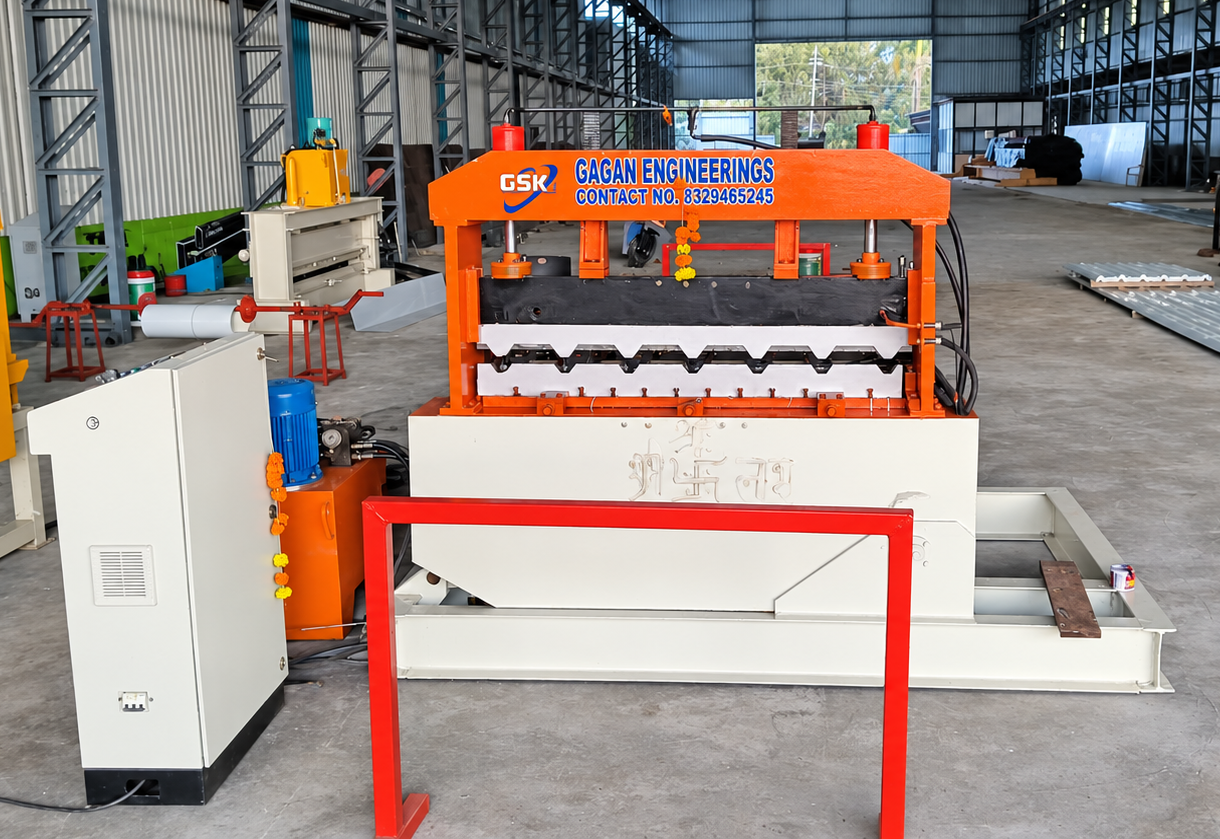
Technical guide for roofing and PEB contractors on automatic curved sheet crimping machines: hydraulic pressing mechanics, radius step calculations, paint protection, and arch canopy structural engineering.
Introduction to Curved Sheet Crimping
Curved metal roofs are a cornerstone of modern industrial and commercial architecture. From self-supporting curved warehouse roofs and petrol pump canopies to airport hangars, sports stadium spectator stands, and bulk grain storage domes, arched roofing provides superior aerodynamic wind resistance, natural rain shedding, and expansive clear interior spans without internal support columns.
However, standard roll-formed corrugated or trapezoidal roofing sheets are rigid longitudinally and cannot be manually bent around tight structural curves without buckling and kinking. Producing structurally sound curved roofing panels requires an Automatic Roofing Sheet Crimping Machine.
Manufactured in Khopoli, Maharashtra by Gagan Engineering Works, our automatic hydraulic crimping machines take straight profiled sheets and impart mathematically indexed transverse micro-crimps, transforming flat profiled metal into smooth, rigid circular arches.
How Hydraulic Step-Crimping Forms Smooth Arches
Rather than using a continuous bending roll, which would crush trapezoidal ribs and round corrugated crests, our machine employs precision step-crimping:
- Profile-Matched Dies: Hardened upper and lower pressing dies precisely match the cross-sectional shape of your roofing profile (trapezoidal rib or sinusoidal wave).
- Calibrated Compressive Indentation: The hydraulic press jaw closes with controlled tonnage, pressing a slight, permanent transverse indent into the sheet valleys and rib shoulders.
- Automated Step Indexing: A motorized feed carriage advances the sheet forward by a pre-calculated distance (e.g. 15 mm to 30 mm), and the crimping cycle repeats automatically.
- Smooth Apparent Radius: Because each micro-crimp imparts a fraction of a degree of angular deflection, a succession of 50 to 150 closely spaced crimps produces a visually flawless, structurally rigid continuous circular arc.
Technical Comparison: Automatic Roofing Sheet Crimper
| Feature | Manual / Semi Crimper | Gagan Engineering Automatic PLC Crimper |
|---|---|---|
| Operation Mode | Manual Hand Feed & Foot Pedal | Fully Automated Servo/Stepper Indexing Table |
| Supported Width | Up to 1000 mm | Up to 1250 mm Standard Wide Profile |
| Sheet Thickness | 0.35 mm – 0.50 mm | 0.30 mm to 0.80 mm (Heavy Gauge Capable) |
| Minimum Radius | 3.5 Meters | 2.0 Meters (Ultra-Tight Curved Canopies) |
| Cycle Speed | 10–15 crimps / minute | 25 to 35 crimps per minute |
| Arc Calculation | Manual Trial and Error | PLC Radius & Chord Length Auto-Calculator |
| Die Metallurgy | Mild Steel 45# | Vacuum-Hardened Cr12 Alloy Steel (58–60 HRC) |
| Hydraulic Pack | 3 HP Standard | 5.0 HP Yuken Power Pack with Oil Cooler |
Calculating Crimp Pitch & Arc Curvature Radius
The relationship between crimp depth, pitch interval, and the resulting arc radius is mathematically determined:
• Tight Radius (2.0 m – 4.0 m): Requires a short step pitch (12–18 mm) with deeper crimp indentation, commonly used for canopy eaves, bullnoses, and agricultural silos.
• Large Radius (8.0 m – 25.0 m): Requires a wider step pitch (25–40 mm) with gentle indentation, ideal for grand warehouse arched roofs and aircraft hangars.
With our Delta/Siemens PLC touchscreen console, the operator simply inputs the building span and rise, and the controller automatically computes the step sequence for consistent curvature across the entire production batch.
Preserving Paint & Zinc Coatings on PPGI/GP Sheets
The biggest risk during crimping is paint flaking, micro-cracking, or zinc coating delamination on pre-painted coils. Gagan Engineering solves this through:
1. Precision CNC-radiused die contours with zero sharp transition edges.
2. Vacuum-hardened Cr12 alloy tool steel with mirror polish finish.
3. Controlled hydraulic pressure regulation preventing excessive localized stress on paint primers.
Contractor Procurement & Sizing Guide
When investing in a curved roofing sheet crimping line, verify:
• Profile Interchangeability: Can the die blocks be unbolted and swapped if your factory introduces a new roofing sheet profile?
• Infeed and Outfeed Support: Verify the provision of motorized or free-wheeling roller support tables (at least 6 meters infeed and 6 meters outfeed) to prevent sheet sag.
• Hydraulic Reliability: Ensure genuine industrial hydraulic valves (Yuken/Rexroth) with continuous thermal cooling for non-stop summer operation.
For engineering specifications, profile testing on your sheet samples, and manufacturer pricing, explore our Automatic Roofing Sheet Crimping Machine Product Page or contact Gagan Engineering Works at +91 83294 65245.