Trapezoidal Roofing Sheet Making Machine: Working Principle, Profiles, Specifications & Buying Guide
Published: October 28, 2026 | By Gagan Engineering Technical Editorial Desk
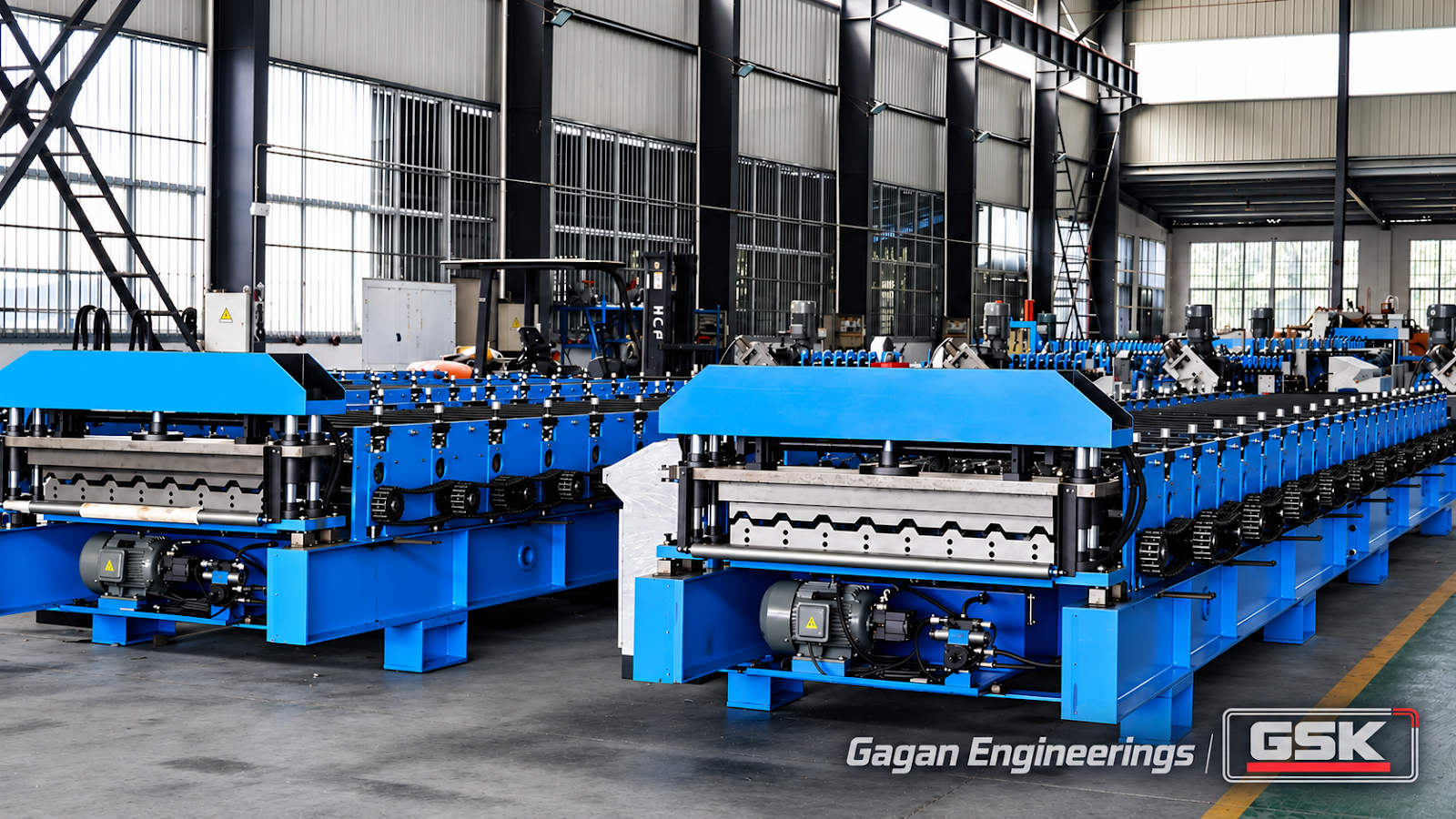
Comprehensive engineering guide to trapezoidal profile roll forming machines. Explore rib profiles, 18–22 forming stations, material compatibility, and buyer ROI in India.
1. What is a Trapezoidal Profile Roll Forming Machine?
A Trapezoidal Profile Machine (also designated as a trapezoidal roofing sheet roll forming line or box-profile sheet maker) is a continuous industrial cold roll forming system engineered to convert coiled sheet metal into rigid, longitudinal trapezoidal-ribbed panels. Unlike stamping or press brake operations that form metal in batch strokes, continuous roll forming feeds flat strip through progressive sets of contoured roller dies mounted on heavy-duty stands.
Each stand imparts an incremental degree of plastic deformation along the transverse axis. By distributing the forming strain across 18 to 22 sequential stations, the machine prevents metallurgical stress concentration, edge thinning, paint cracking, and oil-canning waviness. The finished output is a precision-profiled panel featuring raised trapezoidal crests, sloped webs, flat drainage valleys, and an anti-capillary siphon groove designed for high-load industrial roofs, commercial wall cladding, and pre-engineered buildings.
Manufactured in Khopoli, Maharashtra by Gagan Engineering Works, our automatic Trapezoidal Profile Machine pairs high-carbon EN31/Cr12 vacuum-hardened rollers with optical encoder length tracking and a profile-contoured hydraulic guillotine shear, delivering reliable 18–25 m/min production speeds for metal fabricators and roofing manufacturers.
2. Trapezoidal Sheet Profile Anatomy & Structural Engineering
The geometric profile of a trapezoidal sheet is engineered specifically to maximize section modulus (bending resistance) while optimizing sheet cover width from standard commercial mother coils (1220 mm or 1250 mm input width):
Key Profile Dimensions:
• Rib Height (Crest Depth): Typically ranges from 28 mm to 35 mm in standard commercial roofing (and up to 45 mm in deep-rib heavy industrial profiles). Higher ribs drastically increase load-bearing strength across long purlin spans.
• Rib Pitch (Crest-to-Crest Distance): Typically spaced between 200 mm and 250 mm center-to-center across the sheet, creating 4 or 5 primary structural ribs across a standard 1000 mm / 1050 mm effective cover width.
• Valley Width (Drainage Trough): The flat pans between crests provide expansive hydraulic discharge channels, facilitating rapid water runoff during heavy monsoon storms.
• Anti-Capillary Siphon Groove: Formed on the under-lapping side rib, this subtle secondary bead breaks capillary action, preventing moisture from siphoning upward into the building through the side lap seam.
• Stiffening Ribs / Flutes: Secondary micro-grooves rolled along the flat valley floors that eliminate oil-canning and increase longitudinal torsional rigidity on thinner steel gauges (0.30–0.45 mm).
3. Technical Comparison: Trapezoidal Ribs vs Sinusoidal Corrugated Sheets
Metal roofing buyers frequently ask whether they should produce classical corrugated sheets (Tata Nali sinusoidal wave) or modern trapezoidal box profiles. While both are manufactured via continuous roll forming, their structural characteristics, purlin requirements, and target markets diverge substantially:
Technical Comparison: Trapezoidal Profile vs Sinusoidal Corrugated Panels
| Engineering Parameter | Trapezoidal Profile Machine | Corrugated Sheet Machine (Tata Nali) |
|---|---|---|
| Profile Geometry | Raised trapezoidal ribs with flat drainage valleys and sloped webs | Continuous repetitive sinusoidal round waves (76 mm pitch, 18 mm depth) |
| Section Modulus / Stiffness | High sectional stiffness; resists heavy wind uplifts and concentrated point loads | Moderate bending stiffness; distributes uniform loads evenly |
| Purlin Spacing Capacity | 1.2 m to 1.8 m purlin spans without excessive mid-span deflection | 0.6 m to 0.9 m purlin spans; requires closer sub-framing |
| Side Lap Sealing | Engineered overlap crest with integrated anti-capillary drainage siphon groove | 1.5 to 2 wave overlap; relies on crest fastening or sealing tapes |
| Primary Raw Material | Pre-Painted Galvalume (PPGL 550 MPa), PPGI, Aluminium, Galvanized Steel | Galvanized Iron (GI), standard PPGI, colour-coated coils |
| Fastening Method | Hex-head self-drilling screws with bonded EPDM washers | Traditional hook bolts or roofing screws driven through wave crowns |
| Common Applications | Modern industrial warehouses, PEB structures, commercial facades, wall cladding | Rural housing, agricultural poultry sheds, site barricading, low-cost canopies |
| Machinery Tooling Stands | 18 to 22 progressive forming stands for multi-stage angular bends | 14 to 18 progressive stands for smooth radial wave forming |
4. Complete Machine Components & Production Line Sequence
An industrial-grade trapezoidal roofing line operates as a synchronized automated manufacturing cell. The standard production workflow follows six engineered stages:
1. Coil Loading & Decoiling: A 10-Ton Hydraulic Decoiler supports mother coils up to 10,000 kg. Motorized wedge expansion secures coil IDs from 480 mm to 520 mm, while loop sensors and pneumatic disc brakes synchronize unwinding speed with the roll former.
2. Precision Infeed & Guiding: Heavy entry guide rollers align coil edges true to the centerline, ensuring the metal enters the first forming station without lateral drift.
3. Progressive Cold Roll Forming: The metal strip passes through 18 to 22 forming stands. Bottom and top rollers shape the sheet progressively from the center outward, preventing oil-canning and uneven edge tension.
4. Optical Rotary Encoder Tracking: A high-resolution rotary optical encoder tracks running sheet length with sub-millimeter precision.
5. Hydraulic Profile Guillotine Cutting: The PLC commands the line to pause momentarily (in stop-cut setups), and a profile-contoured hydraulic shear with Cr12MoV vacuum-quenched blades cuts the panel cleanly to programmed length within ±1.0 mm tolerance.
6. Run-Out & Collection: Finished panels discharge onto a heavy-duty 6-meter roller collection table for manual offloading or automatic hydraulic stacking.
5. Roll Tooling Metallurgy: EN31/Cr12 Stands & Hard Chrome Mirror Finish
The durability and surface quality of finished roofing panels depend directly on the metallurgy of the roller dies and shafts:
• Roller Metallurgy: Cheap machinery often uses mild steel (MS) or unhardened EN8 rollers that wear quickly, developing dimensional inaccuracies and scuffing colour coatings within months. Gagan Engineering Works utilizes forged high-carbon alloy tool steel (EN31 / Cr12), CNC contour-turned, vacuum heat-treated to 58–62 HRC, and mirror buffed.
• 0.05 mm Hard Chrome Mirror Plating: Electroplated hard chrome reduces the coefficient of friction to minimum levels, guaranteeing zero scuffing on pre-painted and printed finishes.
• Solid 40Cr Transmission Shafts: Shafts are turned from 75 mm to 80 mm solid 40Cr forged alloy steel, heat-treated, ground, and keyed to eliminate torsional deflection under continuous high-torque duty.
• Drive Mechanism: Driven by an 11 kW helical geared motor through heavy roller chains or independent gearboxes, ensuring vibration-free rotational synchronization across all stands.
6. Raw Material Compatibility: PPGI, 550 MPa Galvalume & Aluminium
A versatile trapezoidal roll former must handle varied raw material coils without edge tearing or tooling reconfiguration:
• Pre-Painted Galvalume (PPGL / Aluzinc 550 MPa): Composed of 55% Aluminium, 43.4% Zinc, and 1.6% Silicon with AZ150 coating. Its high yield strength (550 MPa) requires rigid roller stands and precise roll clearances to prevent springback.
• Pre-Painted Galvanized Iron (PPGI): Standard commercial grade with 245–350 MPa yield strength and 0.30–0.60 mm gauge. Forms smoothly with minimal springback.
• Galvanized Iron (GI / GC): Zinc-coated steel coils conforming to IS 277 BIS standards.
• Aluminium Coils: High-grade 3000 or 5000-series roofing aluminium alloys (0.50–0.80 mm) for coastal environments with corrosive sea spray.
7. Industrial & Commercial Applications for Profiled Sheets
Trapezoidal profile sheets dominate modern architectural and industrial construction due to their structural efficiency and clean visual lines:
• Industrial Warehouse & Shed Roofing: Spanning long bay distances with minimal purlin deflection, lowering total steel framing tonnage.
• Pre-Engineered Building (PEB) Cladding: Serving as primary exterior envelope panels for large-span distribution hubs, manufacturing plants, and logistics parks. For specialized high-tensile 550 MPa PEB lines, explore our PEB Roofing Sheet Making Machine.
• Factory Wall Siding & Partitions: Clean vertical lines provide modern aesthetics while resisting heavy industrial washdowns and mechanical impact.
• Curved Arch Canopies: When curved using an Automatic Roofing Sheet Crimping Machine, trapezoidal sheets create self-supporting curved roofs for petrol pump canopies, grain godowns, and barrel-vault hangars.
• Cold-Room & Insulated Panel Facings: Forming the structural outer skin for polyurethane (PUF) and rockwool insulated sandwich panels.
8. Buyer Procurement Checklist & Pricing Factors in India (2026)
When evaluating an industrial trapezoidal profile line, capital investment typically ranges between ₹15 Lakh and ₹28+ Lakh depending on specification configuration. Before placing an order, verify the following engineering parameters:
1. Number of Forming Stands: 18 to 22 stands are required for 0.30–0.80 mm steel to avoid micro-cracks along rib corners.
2. Shaft Diameter & Material: Insist on solid 75–80 mm 40Cr shafts rather than hollow mild-steel tubing.
3. Roller Plating: Verify 0.05 mm hard-chrome mirror electroplating to ensure longevity on pre-painted stock.
4. Shearing System: Ensure the hydraulic profile blade is manufactured from Cr12MoV vacuum-quenched steel rather than mild steel.
5. Control Brand: Confirm standard industrial PLC and HMI components (Delta, Siemens, or Schneider) with ready replacement availability.
6. Decoiler Selection: A 5-Ton manual decoiler is sufficient for light batch work, while a 10-Ton Motorized Hydraulic Decoiler is essential for continuous high-speed production.
For custom engineering consultations or foundation layout drawings, Contact Gagan Engineering Works or request a direct quotation from our Khopoli manufacturing facility.
9. Frequently Asked Questions (Buyer FAQs)
Common technical questions addressed by Gagan Engineering Works' technical engineering team: